

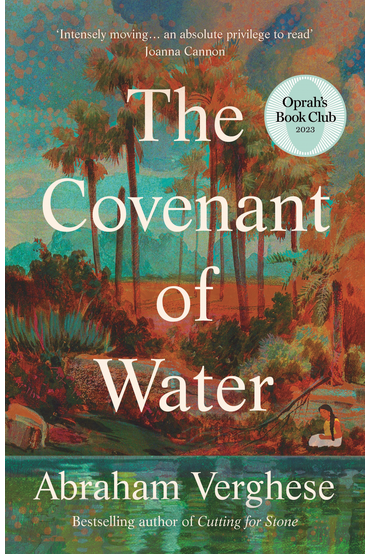
Oprah’s book club pick, is indeed a modern day masterpiece. It’s grand, it’s moving, it’s all encompassing. It’s a historical fiction, a medical mystery and a multigenerational saga. Abraham Verghese’s epic tale, ‘The Covenant of Water’, is all this and so much more. It’s a story that shape shifts its way across generations and timelines, still retaining generosity of the human spirit at its core. It feels like a grandiose gesture on the part of Verghese to have told us this story; something that’s unflinchingly brutal, unapologetically morbid yet when the author writes it the way he writes it, that is to say, so evocatively tethered; it feels tender, considerate and benevolent.
It begins in the year 1900 in the village of Parambil, in Kerala where a twelve year old girl, is about to be married to a 40 year old man. The story progresses, and the girl soon comes to be known as the matriarch, Big Ammachi. She has been married to a man who’s family suffers from a “condition”, the men are afraid of water and the deaths have occurred because of drowning. Nobody is able to explain this strange phenomenon, until Big Ammachi’s granddaughter, becomes a doctor and unearths the mystery behind the “condition”. From 1900 to 1977, the story traverses geographies and politics, medicines and diseases; poetically; introducing us to a plethora of interesting characters and throwing a few riddles along the way. We come across Philipose, Big Ammachi’s son, a writer, who gets lost in his chauvinism and addiction, only to regain his lost ardency. His tumultuous relationship with Elsie, stands out in the prose, due to its fecklessness, its reality rooted in ambivalence and ego. Elsie, is stoic yet yielding, an artist who is wronged by Philipose’s austere callousness and detachment. Elsie’s daughter and Big Ammachi’s namesake, is a passionate doctor, yearning to be a surgeon, who is constantly juggling between her familial attachments, medical duties and heartaches. Her discovery of the “condition“ is a sublime moment in medicine; a moment that stands still for its enormity and humility.
Verghese also acquaints us with a myriad of interesting doctors. Rune Orqvist, a clinician extraordinaire, committed to his profession and people, opens a leprosarium, not just to treat leprosy, but to heal its ostracism, and provide patients with empathy and kindness. Digby Kilgour, misunderstood and misplaced, often lost in predicaments of love and longing, finds his calling in the leprosarium. The moments leading upto it, though seeped in pathos and despondency, ultimately celebrate resilience.
Abraham Verghese has a gift for words. His words, his text, interspersed with Malayalam, are so detailed yet exact. He transports us effortlessly to Parambil, Glasgow, Madras; so much so that it begins to feel like we are witnesses to the happenings in the narrative. A colonial India and an Independent India get beautifully worded; the former has angst, desperation and bondage, while the latter has a bittersweet joyous effervescence. It’s incredible to note the tapestry of the language as he describes the topography of Kerala in the 1900s. Similarly his musings with Madras city are so thorough. Just as geography provides the lush landscape to Abraham’s story, emotions provide a realness to the words. They form the undulating subtext to each of the characters’ struggles in undoing their trials and tribulations. The author provides an incredible emotional arc to each of them. Their internal struggles in coping with their unresolved traumas, and unspoken mental issues often gets reflected externally in their unparliamentary conversations and wrong decisions. This dichotomy of distress gets explored by Verghese subtly and sensitively. Also poignant and piercing are the conversations on caste between Philipose and his lower caste pulayan friend Joppan.
Death and disease form an integral part of this narrative. Since the author is a doctor, medicine gets centre stage in the proceedings. It’s magnificent to note the diagnoses being made in the early 1900s. He doesn’t shy away from getting into the details of the anatomy, physiology and grotesque pathology of it all. The surgical scenes are almost musical, so anatomically accurate. Leprosy, a disease such, that even the pen refrains from writing about it, gets its biggest attention since the medical textbooks. The conscientious decision to portray a disease that’s synonymous with exclusion and abandonment, is humbling.
It is a big book, but an easy read. Abraham Verghese’s words are captivating and commiserating. It’s a story of epic proportions and is told such. Every character adds layers and nuances to this riveting family and medical drama. There lies an undercurrent of melancholy in every page. There remains an enigmatic dread at every turn. However, the author infuses hope even in the moments of despair by singling out compassion, love and kindness in his characters and situations.
The Covenant of Water, is a triumph of human spirit. It leaves you feeling calm and contented long after you have finished reading it.
~ JUST A GAY BOY. 🥹✨

 the shiny diaries