

📍 Dominican Republic 🇩🇴
Alma Cruz is a successful writer in the US. Even with all her fame and wealth, she constantly has this gnawing sensation that something’s missing. One day she decides to move from Vermont to her homeland, Dominican Republic, in the pursuit of peace and happiness. This decision is met with a lot of opposition and criticism from her other three sisters. Nonetheless, she moves to her country and decides to open a cemetery in the backyard of her house. When the locals hear about this oddity of a plan, they gossip, eavesdrop and even scramble to secure a job at this cemetery only to know that this cemetery would be for all the unfinished manuscripts and stories that Alma as a writer began earnestly but could never finish.
To bring this cemetery to fruition, she hires an architect who starts building sculptures of the people beside the graves where their stories lay buried. To do the upkeep of the cemetery and maintain the house, Alma also hires Filomena from the neighbourhood. As Filomena starts working at the cemetery, the sculptures start coming to life and start telling their stories. Bienvenida talks about her distraught life, her troubled marriage with the dictator el Jefe (Trujillo), his second marriage to his mistress because of Bienvenida’s miscarriages, his decision to exile her, the premeditated reconciliation during the exile that leads to Bienvenida’s pregnancy, and later forcibly separating the daughter from her under the pretext of a safe and secure upbringing. Filomena too starts chatting about her life, the feud with her sister Perla, the unconditional love for her nephew Pepito, the estrangement between the sisters and a recent tragedy that forces understanding between them. As the stories intermingle, and the characters real and unreal get candid with their lives, we soon realise that these stories aren’t separate, instead are interconnected.
Alma comes across as a stoic, independent, intelligent woman who remains resilient through her unconventional choices. She straddles her immigrant identity, the realities of being Dominican American and the belongingness to her Dominican heritage. She oscillates between the rights and the wrongs, but remains resolute with her decision, no matter the consequences. Filomena, is a harbinger of unconditional love despite a tedious and lonely life. Others’ selfishness never extinguishes the selflessness that’s inherent in her. Bienvenida’s docility and fragility shouldn’t be mistaken as her personality for they tend to overshadow her grit and perseverance.
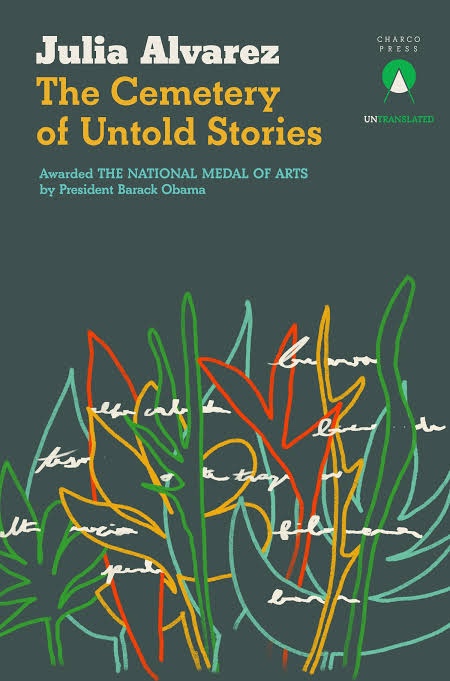
Julia Alvarez’s latest book, The Cemetery of untold stories, was my pick for September’s Hispanic Heritage Month. Julia is a poet, novelist and essayist and is regarded as one of the most significant contemporary Latina writers. The book is unique not just because of its plot line that indulges in magical realism but also the language and writing style. Spanish is generously interspersed with English, to the extent that I thought the book was written in Span-glish (if that could be a word!), which I thoroughly enjoyed. The author has taken her time to build the story, she has let the characters grow with the story; almost as if one is uplifting the other in a surreal symbiosis. There’s also an interesting queer character in the book. Dominican culture, geography and politics form an integral part of the narrative and Alvarez proudly flaunts all its naïveté and nicety.
The Cemetery of untold stories is Julia Alvarez’s allegory to letting go and providing oneself the proverbial closure to everything that has remained incomplete and insufficient. Quite poetic, indeed!
~ JUST A GAY BOY. 😎

 the shiny diaries