Prophet Song

Winner of the 2023 Booker Prize, Prophet Song is deliberately dark and perversely poignant. Set in contemporary Ireland, the story is about Eilish Stack, who is a molecular biologist by training and working in biotech in Dublin. She has four children, one being an infant, Ben. The story begins when Larry, her trade unionist husband is taken in for questioning by government officials. While Eilish receives no news about Larry despite her umpteen attempts to contact him or the officials; the country is soon descending into a political quagmire. A right wing “National Alliance Party” stakes claim to be the government and begins attempts to fight the anti-nationals and the rebels. Totalitarianism sees a rapid ascent and fascism soon starts dominating every aspect of civilian life. Freedom becomes conditional, defence forces become authoritarian, paving the way for a deadly civil war.

Eilish remains forever worried about Larry, wondering whether he’s even alive. Her eldest son Mark joins the rebels and soon disappears. Her other son Bailey, remains angst ridden and obstinate. Her daughter Molly remains her only support through this ordeal. As Eilish battles her anxieties, her insecurities, her losses, her grief, her helplessness, her hopelessness, and simultaneously care for her infant and a rapidly progressing dementia suffering father; she needs to make a decision if she has to leave the country or cross the borders illegally; as the society around her continues to disintegrate, and life becomes an endless cacophony of gunshots, sirens and missile strikes.

Paul Lynch’s prose can be generalised as an urgent and compelling commentary on the steady rise of totalitarianism in the world. His writing has a claustrophobic atmosphere, a sense of foreboding and is suffused with an unrelenting uneasiness. Lynch evocatively translates Eilish’s impuissance and anxiety into his words and onto every page. The scenes where Eilish expectantly awaits Mark’s phone call and when she goes hospital to hospital in search of her injured child are especially gut wrenching, depicting an awful sense of dread. The writing almost feels like a stream of consciousness; there are sections and chapters in the novel but no paragraphs. The dialogues between characters are without any punctuations; so much so that, there’s no difference between a thing said and a thing thought.

Now, Prophet Song may have been set in a dystopian Ireland, but closer home dystopia may soon become a reality. Economic development has been used as a tool to conceal fascism and autocracy. Jingoism and zealotry are being given a free run while any form of dissent is being deemed antinational and subsequently penalised. If you are one amongst many who still chooses to look the other way as this is happening right now, and thinking ‘this won’t/ will never affect me’; read Prophet Song. Paul Lynch was probably imagining an Ireland like that, but we don’t have to imagine it.

~ JUST A GAY BOY. 👿
A stone is most precious where it belongs

This book is a compelling narrative on Uyghurs; their life, culture, geography and the strife unleashed upon them by the Chinese government or the CCP (Chinese Communist Party). The Uyghurs are a Turkic ethnic group from the autonomous region of Northwest China known as East Turkestan, which has been renamed as Xinjiang by the CCP. Modern Uyghurs are primarily Muslims and they are the second largest predominantly Muslim ethnicity in China after the Hui. The modern Uyghur language is classified under the Turkic language family and has an Arabic script. Gulchehra Hoja, author of this book, has written a memoir and through that, has encapsulated the trials and tribulations of her people and the ongoing modern day genocide.

Hoja, born and raised in Ürümchi, the capital of the then erstwhile East Turkestan, comes from a lineage of musicians and artists. Her family was known for their contributions towards the Uyghurs’ cultural landscape, and she had a very liberal upbringing. Gulchehra, upon completing her studies was chosen to be the face of Xinjiang Television’s children’s show. Whilst the show initially started off as a celebration of Uyghur culture and traditions, it gradually morphed into a CCP propaganda piece. Soon she realised how little to no control she had in the proceedings of the show and that, that she was becoming a puppet at the hands of the Han authorities running the channel. Now, the Chinese government had always wanted complete control of the Uyghur region and had started asserting their supremacy by sending Han Chinese civilians to live and work there. Chinese language was forcibly introduced in schools and other governmental establishments. Uyghur civilians were finding it more and more difficult to be themselves or practice their faith. The more Gulchehra understood the threats to her freedom and her Uyghur people, the more uncomfortable she got. One fine day, when she got an opportunity to go to Europe, she learnt starker truths and gory details of the Chinese government in the programmed oppression of the Uyghur, thanks to the free internet available in Europe. This prompted her to make a life changing decision to go America and work for Radio Free Asia (RFA), which simultaneously meant that, she could never come back to her land and her family.

As a journalist at RFA, Hoja gave the Uyghurs a voice that could be heard all across the globe. She brought to light the brutality and racial killing perpetuated by the CCP while promoting their ethnocentric agenda. This bold and fearless reporting only meant trouble for her family back home. She was soon branded as a separatist/ terrorist and her immediate and extended family were imprisoned and treated in the most inhuman way possible. Gulchehra battled immeasurable feelings of guilt and sorrow, but she continued her reporting nonetheless. Her personal life was a complete mess too, with an estranged husband and a budding love interest. However, Gulchehra remained committed to her Uyghur people, never lost focus of her responsibility towards them and through this extremely difficult journey, she portrayed her resilience, compassion and bravado.

What is happening to Uyghurs, is a genocide. The Islamophobia that is rampantly being broadcasted by the CCP is dangerous. There’s genocide happening of the Palestinians by apartheid Israel as well. The world, somehow has turned a blind eye to these genocides and various such Islamophobic propagandas. As I read this book, a chill ran down my spine. The measures taken by the CCP for this ethnic cleansing include detention camps (euphemised as vocational skills education training centers), forced sterilisation, disappearance of dissenting civilians, torture, violation of privacy, hi-tech mass surveillance, religious persecution, unreasonable incarcerations, suppression of free press. Now, only an imbecile or a fanatic should be able to not draw parallels to the situation here at home. Maybe there aren’t any detention camps or forced sterilisations yet, but Islamophobic rhetoric has become mainstream. And if you broaden the scope and look beyond the lens of any kind of phobia, you shall note that this is signalling of a rise in autocracy and complete totalitarianism. Let’s not shun an Uyghur or a Palestine as a localised geopolitical issue. The fanaticism used in this oppression has worldwide ramifications and replications. After the Holocaust, the world vowed that it would never ever allow another humanitarian catastrophe. Yet in 2023, we are not only seeing such events and genocides happening but also becoming widespread. How many more of such massacres would it take for the world, for us to get out of our ignorant slumber?

~ JUST A GAY BOY. 🥺

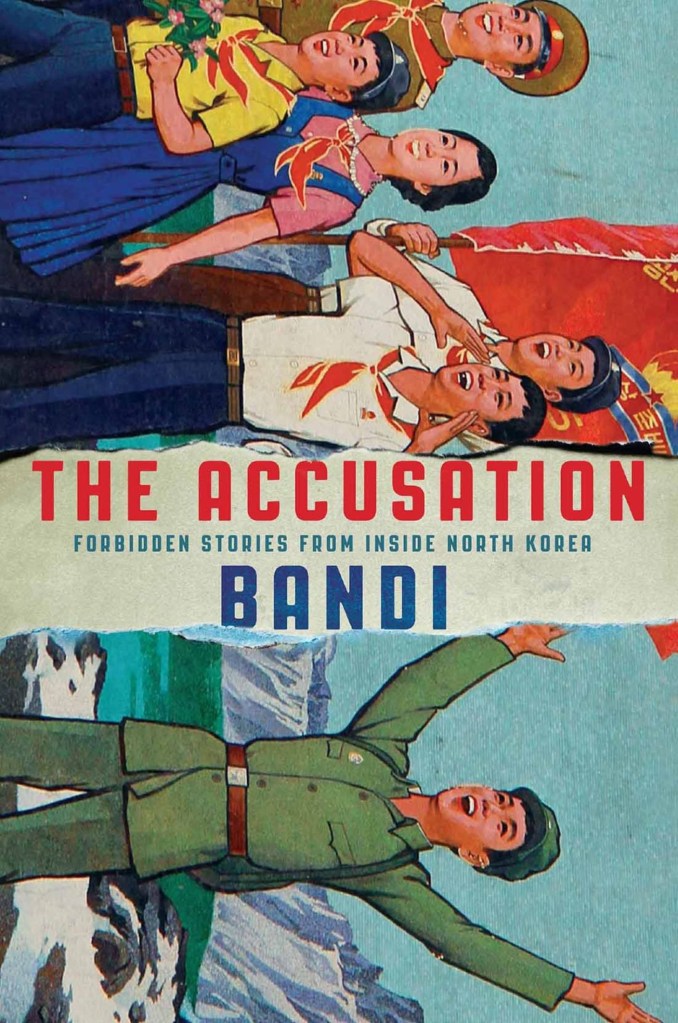
The Accusation: Forbidden Stories from inside North Korea

📍 North Korea 🇰🇵

This book has shocked me like no other. I am still astonished about the fact that, there still exists a country in this world like North Korea. A one of its kind country which has the lives of it’s citizens staged. A country where the autocratic leaders expect performances and accolades from their ‘captive’ citizens for simply existing in their thrones. A country which denies and violates all human rights, is akin to an open air prison.

Bandi, meaning firefly, is the pseudonym for the North Korean writer who might still be living under the oppressive regime. The book, shrouded in controversy over its origins, was written from 1989 to 1995, and was eventually published in 2013 in South Korea, and was later translated by Deborah Smith. The process involved in its publication which included smuggling the clandestine manuscript out of the country was an adventure in itself.

The book is a collection of seven short stories, the underlying theme of each being misery. What makes it even more heart wrenching is the fact, that the miserable and oppressed North Koreans can’t even utter a word about it, let alone against it. The autocracy has cast such a spell on everyone that many are unable to even recognise their plight and suffering. For them, this is the normal way of life. Two stories stood out for me. In So Near, Yet So Far, a young man Myeong-chol is desperate to see his ailing mother who is in a remote village, but is denied permit to visit because of a Class One event. Despite his futile attempts to hoodwink the authorities, he’s unable to see his mother and ultimately ends up in a torture prison. In the story, The Red Mushroom, Hoe Yunmo, is a newspaper reporter, who has been entrusted with writing an article on N town’s bean paste factory returning to normal production levels. However the truth is starkly different. During his investigation he discovers the deplorable conditions of the workers involved but is never able to write about it. The story portrays a writer’s helplessness and frustration in North Korea.

The book can be an eye opener for us. North Korea prides itself on its totalitarian leadership and propaganda. As you read the book, you get an idea, that other than the capital, Pyongyang, the rest of the country is battling severe famine, malnutrition and disease. However, propaganda by the Great Leader and the media, paints a completely different picture. If we contemplate, it won’t be too difficult to draw parallels with our own present situation. We are voting for propaganda, hailing religious sentimentality and jingoistic media and journalists, centering divisive rhetoric, celebrating non performance disguised under the veil of fanaticism and radicalism; and dismissing democracy, criticism, opinions, and humanity at large. Are we under a spell too? Is there a way out?

I hope every Indian reads this book.

~ JUST A GAY BOY. 😧

The Tale of Aypi

Country : Turkmenistan 🇹🇲

This book set in Turkmenistan, focusses on the lives of the inhabitants of a small Turkmen fishing village located on the banks of the Caspian Sea. As the story begins, the people have been ordered by the central government to relocate to a nearby city and have been forbidden from fishing, since the government plans to build a hospice in the village along the coast. As the villagers acquiesce to the pressure, and lament on their loss; there’s one defiant man though, Araz, who takes it upon himself to fight the authorities against their autocracy, and also his own village folks against their docility and subservience. Araz’s story is interwoven with the fable of Aypi. Aypi was a girl from the same village known for her beauty and is wrongfully killed for her so-called transgressions then. Now, centuries later, Aypi comes back to haunt the villagers and confronts their unconcerned, chauvinistic and vapid behaviours. Through Aypi, the author depicts society’s nonchalant normalisation of patriarchy and misogyny. With its myriad other characters and their interpersonal dialogues and arguments, the book constantly debates the traditional versus modern ways of living.

While the events in the book take place during the country’s Soviet past, the author’s depiction of its authority then, is as much a social commentary on modern-day Turkmenistan’s totalitarian governance. This book is one of the first from Turkmenistan to be translated into English (by W.M. Coulson) for the international market. Despite being the country’s most internationally recognised and appreciated authors, A K Welsapar’s books have been banned in Turkmenistan. He was exiled in 1993 and currently lives in Sweden.

Though this story is about Turkmenistan, one can draw parallels to current day India. That’s the most disturbing bit.

~ JUST A GAY BOY. 😓