Behind You Is The Sea

The book is a collection of stories by Palestinian Americans living in Baltimore. Each chapter is dedicated to a different character and as you read along, you realise all of these characters and their families are interconnected. 

With this book, the author, Susan Muaddi Darraj, has tried to reflect upon the intergenerational chasm that exists inevitably and yet how the various generations are inextricably linked. Though Palestinian heritage is the commonality, the newer generations are more American than Palestinian in their personalities and perspectives. This remains the bone of contention among the older folks who are unable to make peace with their diasporic status and are torn living a life that oscillates between reminiscences and resentments. 

The book also tackles some serious issues that plague the Palestinian society such as honour killing, patriarchy, chauvinism, domestic violence and misogyny. Women are expected to be subservient to men, regardless of their achievements. The chapter in which a father is disgruntled and disowns his daughter for having an abortion sans marriage and having a Black boyfriend is unnerving. The chapter wherein a mother constantly chastises one of her professionally successful daughters for being divorced and not having children in comparison to her other daughter who is married and has numerous children, speaks highly about internalised patriarchy. Only the last chapter takes place in Palestine, when one of the characters is forced to bring his father’s corpse to Palestine for burial as per his last wish. What was supposed to be a solemn event, turns into an emotionally frustrating exercise when the son learns the benevolent side to his father’s personality, especially when not even an iota of that benevolence was ever bestowed upon him or his sister. 

Susan Muaddi Darraj is a Palestinian American writer who has authored several collections of fiction, young adult and children’s books. She is the recipient of various awards; winning the Arab American Book award in 2021 and 2016 for Farah Rocks and A Curious Land, respectively. A Curious Land was also shortlisted for Palestine Book Award. 

Behind You Is The Sea, my pick for Arablit April, was a unique reading experience for me because this was the first Palestinian book that I have read, (and I have read a few!) that spoke about Palestinian Christian families compared to the majority of Palestinian literature that is about Palestinian Arabs. Palestinian Christians form a sizeable minority in Palestine and the book helped me understand the inseparability and intertwining of Christian and Arab cultures. 

Now, almost all of the social ills highlighted in this book are inherently prevalent in our Indian society. This goes to show that Indians and Palestinians are not very different because we were all colonised people and carry the repercussions of the British colonisation and occupation through generations. Having said that, it doesn’t mean we continue to have these colonial hangovers till today. Yet somehow, the general Indian population now supports Israel, a current day coloniser, who has mercilessly and relentlessly continued the genocide in Gaza since October 7, 2023. Have we forgotten our own history or has the prevailing Islamophobic jingoism made us all intellectually bankrupt commentators?

~ JUST A GAY BOY. 🍉

Daybreak in Gaza: Stories of Palestinian Lives and Culture

📍 Gaza 🇵🇸 

Gaza, a city having history spanning thousands of years, that once celebrated life and laughter has now become synonymous with death and destruction since the Israeli occupation began. It’s become a graveyard of lost lives, homes and hopes. The book, Daybreak in Gaza, is an anthology of essays and short stories by Palestinians from Gaza, West Bank and the diaspora who recount an erstwhile Gaza, a Gaza of their dreams, a Gaza of their grandparents and great grandparents and a present day Gaza that is witnessing a relentless genocide from the 7th October, 2023. Many of the writers give first hand accounts of the bombing and devastation that has happened mercilessly in front of their eyes. Some of the stories are diary entries as bombs go off in the background, buildings collapse and cries of despair echo constantly. Some of these writers have been killed in the ongoing war. 

Gaza has been reduced to a rubble, Gazans as a statistic. This book, has allowed a different version of Gaza to be seen, albeit the grave circumstances currently. We see Gaza as a thriving center of trade, culture, education and living prior to the Nakba of 1948. Through the various stories we are introduced to the rich history of the city and Palestine even after the Nakba and all that followed with the Egyptian occupation to the First and Second Intifada and the Oslo Accords which turned out to be criminally counterproductive to the Palestinians. And then there are the horrifying, heart wrenching, soul shattering stories of the ongoing genocide replete with unimaginable sorrow that makes this book such a necessity.

Daybreak in Gaza is a difficult read. But to think about it, can this difficulty even come close to the horrendous atrocities being meted out to Gazans since forever and especially now since October 7th, 2023? After every chapter I had to pause. Because every chapter, every page, every word is imbued with the hurt and anger that the Gazans are facing. This book is drenched in their tears and wails that the world has turned a deaf ear to. This book is a testament to their rightful hatred towards all of us for our cowardice and consent for the genocide. 

Daybreak in Gaza has been edited by Mahmoud Muna and Matthew Teller with Juliette Touma and Jayyab Abusafia. Mahmoud is a writer, publisher and bookseller from Jerusalem. Matthew is a UK-based writer and broadcaster. Juliette works for the UNRWA and Jayyab is a London-based journalist from Jabalia refugee camp in the north of Gaza.

As of 5th November, 2024, 200,000+ Palestinians are projected to have been killed by Israel and the USA in Gaza since 7th October, 2023. Two thirds of the buildings have been damaged or destroyed by the Israeli occupation forces. The $3.8 billion in annual U.S. military aid to Israel, which is part of a $38 billion, 10 year deal signed by the Obama administration (2018-2028), has supported the occupation and the ethnic cleansing. Since October 2023, at least another $17.9 billion have been funnelled into Israel’s military. 

How have we let this happen? Is this the world we are a part of wherein a certain population can be ethnically cleansed while no one bats an eyelid? Is this the world where we still call America the greatest country and completely ignore its acts of terrorism? I think we certainly are. 

I shall end my review with these quotes from the book;

From the chapter, My heart is broken, by Saba Timraz:

Has our life become a game, controlled by America and the occupier? They kill, destroy and do whatever they can to harm us, and then tell the world that they are the victims, and we are the monsters. We are an occupied people and have been since 1917. Our lands were stolen, our honour was violated, and the building blocks of our lives were destroyed. We want to be liberated and to live in freedom and dignity. We will not surrender our rights, no matter how long it takes.

From the chapter, History will not lie, by Susan Abulhawa:

But history will not lie. It will record that Israel perpetrated a holocaust in the twenty-first century.

~ JUST A GAY BOY. 🍉

Gaza Weddings

Life in Gaza is unpredictable. Hope and desire is fickle too. So what does it take to plan a wedding in Gaza then? Ibrahim Nasrallah’s book talks about the irony of having a wedding in the midst of bombs and death. He uses dark humour, sarcasm and stark realism to convey the misery and hopelessness that abound life for Gazans. Through the two protagonists, Amna and Randa, the book provides a cataclysmic account of Palestinians in Gaza under the Israeli occupation.

Randa, is an aspiring journalist, who’s identical twin sister, Lamis is in a courtship with Amna’s son Saleh. In the book, Amna keeps talking to her husband who’s in hiding while Randa talks to the readers directly. Death is so commonplace in Gaza that no family is unknown to its horrors and the brutality of the occupation. Amna is bereft after she hears about the suspected death of her husband but is unable to identify him since it’s so badly disfigured. Saleh is unable to process his father’s martyrdom and becomes emotionally unstable. Towards the end, the story depicts the death of one of the twin sisters. We never know who is dead.

Ibrahim’s writing is part lyrical, part biting. Death, tears and sadness form the canvas on which he paints the precarious lives of Palestinians. Bittersweet reminiscences and pervasive foreboding become everyday nuances for Amna and Randa. Joy and laughter feel misplaced and unnatural when there’s grief lurking at every turn. Ibrahim Nasrallah is a Palestinian writer, poet, artist and photographer with an extensive body of work and has been the winner of the Arabic Booker Prize in 2018. The book has been translated into English by Nancy Roberts who is known for her translations of Arabic literature.

As of 13th March, 2024, 31,200 Palestinians have been killed in Gaza and more than 72,800 have been injured since Israel began the genocide on October 7th, 2023. There’s no life in Gaza literally. Those who have survived the bombs and Israel’s ethnic cleansing, are now starving to death. The current day Holocaust is going unchecked and unabated as the world continues to look the other way. How are we ever going to face ourselves in the future? For how many years will Israel and its comrades, especially the United States, will have to beg for forgiveness? Should they ever be forgiven then?

~ JUST A GAY BOY. 😞

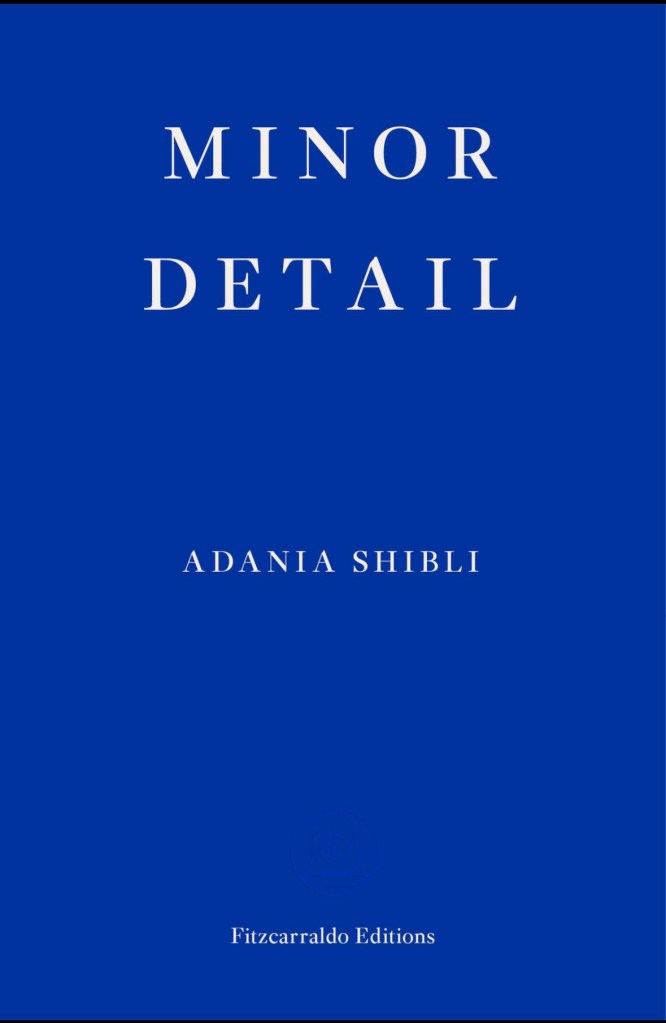
Minor Detail

📍 Palestine 🇵🇸

This novel has two parts. The first one is set in the year 1949, just after the Nakba of 1948. An Israeli officer is scouring the Negev desert for any remaining Arabs or Arab settlements. The blistering heat, a festering infection, dust, sweat do not deter him from going about his day in a regimented way. His single handed determination to find Arabs does lead him to a Palestinian girl, who is forcibly brought back to the Israeli military camp, where she is gangraped by the soldiers, later killed and buried in the sand. The second part, begins in the city of Ramallah, where a young Palestinian woman sets out to investigate this crime that happened 25 years ago. As she juggles her way through the innumerable military checkpoints in the West Bank and on her journey to the desert, she is also juggling anxiety and panic that have become ubiquitous in her life due to the Israeli occupation. Her single handed determination to find details about the gruesome incident despite the unforgiving heat through the lonesome desert unfortunately leads to a tragic penultimate moment.

The book is an uncomfortably simple yet unflinchingly honest prose on Palestine and Palestinian people living under the occupation and an apartheid regime. The first half focusses on the daily mundane activities of the officer over and over again, so much so that the brutality that occurs becomes a part of the same mundane. In the second half, the author literally places us in the passenger seat of the woman as she takes on the perilous journey, and we get to experience first-hand her anxiety, fear and trauma muddled in her determination and longing to unearth the truth. The author deftly shifts the narrative perspective from the Israeli officer whose intention and purpose is annihilation of Palestinians, to the Palestinian woman whose reality is obscured and dependent on the military occupation. Freedom is villainous in one while it’s the prisoner in another. Life is precious in one while for the other, death is a close ally.

Adania Shibli is a Palestinian author and essayist, born in Palestine, who has written three novels and lives between Jerusalem and Berlin. Minor Detail, translated from Arabic to English, by Elisabeth Jaquette, was longlisted for the International Booker Prize in 2021 and was also nominated for National Book Award for Translated Literature in 2020.

As of December 11th, 2023, over 17997 civilians which include 7729 children have been massacred in Gaza since the genocide began on October 7th, 2023. The dehumanisation of the Palestinian people by the entire world has never been more stark and atrocious. The global silence on the oppressed and the selective empathy towards the oppressors is a new abysmal low for our collective humanity. The total disregard towards the ethnic cleansing of the Palestinians, the absolute subservience towards the Israeli propaganda of self defence, the failure to distinguish between antisemitism and zionism is a telling of the dark times we are in. The next time when the world’s so called superpowers call for peace and human rights, you can gawk at the irony of it.

~ JUST A GAY BOY. 🇵🇸