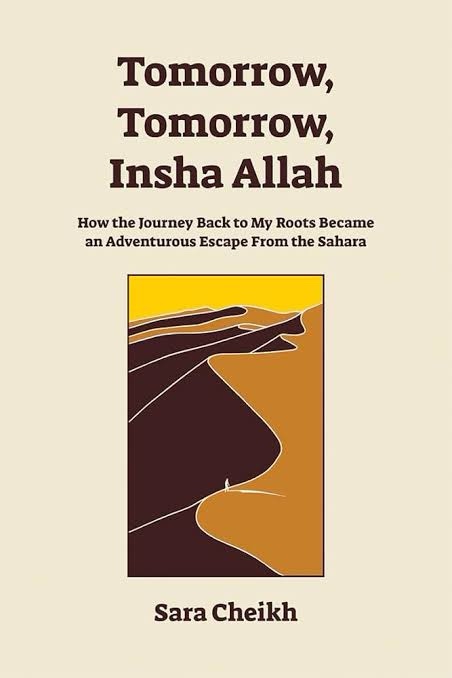
Tomorrow, Tomorrow, Insha Allah

📍 Western Sahara 🇪🇭

Western Sahara is a disputed territory on the northwest coast of Africa and is among the most arid and inhospitable on the planet. Colonised by Spain until 1975, about 20% of the territory is controlled by the Saharawi Arab Democratic Republic (SADR); while the remaining 80% is occupied and administered by Morocco with tacit support from France and the United States. A nationalist movement, the Polisario Front, has proclaimed the rightful leadership of the SADR with a government in exile in Tindouf, Algeria. The UN considers the Polisario Front to be the legitimate representative of the Saharawi people and maintains the Saharawis have a right to self determination. Western Sahara is the last African colonial state yet to achieve its independence and has been dubbed “Africa’s last colony”.

The book is a memoir of the Saharawi author, Sara Cheikh. Born in the Smara refugee camp in Tindouf, where she lived till the age of six, Sara later immigrated to Spain and is currently living in Paris. In the March of 2020, Sara decides to travel to Western Sahara to see her grandmother, Noa; just when the world is discovering about Covid-19. Despite a very uncertain and anxious start to her journey from Paris, she travels to Algiers, then Tindouf, then Smara and ultimately to Mheiriz in the liberated territory where she meets Noa and many members of her family. However, by this time, border closures have started happening all over the world and Sara is left panicking if she is ever going to go back to Europe. Her journey back from the desolate desert terrains forms the crux of this story that keeps us, the readers on the edge of our seats.

Sara’s writing is descriptive, nuanced and humorous. She carefully describes the geopolitical situation of the Saharawi people and benevolently introduces us to their culture, traditions and cuisine. The desert forms an important character in the prose and its harshness and kindness has been lucidly illustrated by the author. As you read the book, you discover that Saharawi women are fierce, independent and liberal minded. Sara’s mother, Gbnaha, comes across as this daring go-getter with a charming attitude who is tough and strong willed. The Saharawi men also appear to be supportive, convivial and progressive. The book is peppered with archival and personal pictures of the Saharawi territories and the people. Through the book, Sara tries portraying her juxtaposition as she battles her European upbringing with her Saharawi consciousness and makes a compelling case about a hyphenated existence.

Tomorrow, Tomorrow, Insha Allah is one of those rare books written by a Saharawi talking about the forgotten territory of Western Sahara. With this book, you realise that even in 2024, there’s colonialism present and the same colonisers are giving lessons to the world about freedom and equal rights. What a time to be alive!

~ JUST A GAY BOY. 🥹

Black Foam

📍 Eritrea 🇪🇷

This is a book like no other. The novel, written by Doha based Eritrean novelist Haji Jabir, was originally published in Arabic in 2018 and, is the first Eritrean novel to be longlisted for the 2019 International Prize for Arabic Fiction. It has been translated into English by Sawad Hussain and Marcia Lynx Qualey. The story is about an Eritrean soldier’s relentless pursuit in finding stability, hope and freedom as he traverses from Eritrea to Ethiopia to Israel. Adal fights as a soldier in The Eritrean war of Independence against Ethiopia and sees his country achieve it. While Asmara celebrates the new freedom, Adal changes his name to Dawoud, because he doesn’t want to be associated with it. During his time at the Revolution school there, his infractions lead him being sent to the torture prison at the Blue Valley. He escapes the prison to land in Endabaguna refugee camp in North Ethiopia where he becomes David. From there, he manages to enter the Gondar camp in the Amhara region of Ethiopia, posing as a Falasha Mura (Ethiopian Jew) named Dawit. This helps him in getting to Israel, finally to Jerusalem. This arduous journey which converts him from a soldier to a refugee, whilst he assumes various identities and religions, shakes him to his core; challenges all his beliefs and notions about the world and humanity. Ultimately, he finds a glimmer of solace when he visits the Al-Aqsa mosque in the West Bank region of Jerusalem, Palestine; it appears to him, as if life has come a full circle and there he starts questioning his identity and whether he may now be a part of a community of African Palestinians.

Black Foam is a composite story that, at the outset, through the protagonist’s character highlights the struggles and atrocities faced by a refugee. However, as we delve deep into the narrative, it holds your attention towards a plethora of unspoken issues and peoples. A nation’s independence needn’t necessarily attribute independence to all its citizens. As a soldier, Adal was left stifled living that life, though now Eritrea was free. However, his mindset was such that, he could never accept freedom, which led him from one refugee camp to another. The book also talks about the plight of Ethiopian Jews, who remain at the mercy of the Israeli Jews and live like second class citizens in the country. The story also talks about Palestine and lives of Palestinians living under the apartheid regime of Israel. Whilst weaving a sombre and at times discordant narrative through these complex geographies, the author simultaneously constructs the romantic and sexual life of the protagonist. This juxtaposition in the storytelling is distracting, deliberately pervasive and at times tedious.

Haji Jabir has masterfully sketched this story of a man in search of a home, security, a sense of belonging only to be met by hostility and uncertainty every step of the way. This quest is sadly the tale of millions of refugees in various parts of the world. Kudos to the author for writing it, keeping the despair and depravity alive in every page; for breathing life into the forgotten lives of the refugees; for portraying doom as a running subtext to the entire narrative. The descriptions of Jerusalem, West Bank, Al-Aqsa Mosque, Church of the Holy Sepulchre, is so detailed, nuanced; it’s almost as if we are there with Dawoud/ David/ Dawit as he roams these streets searching and questioning his life’s meaning and purpose.

Black Foam is a bittersweet melancholy that will stay with you long after you have finished reading it.

~ JUST A GAY BOY. 🥺

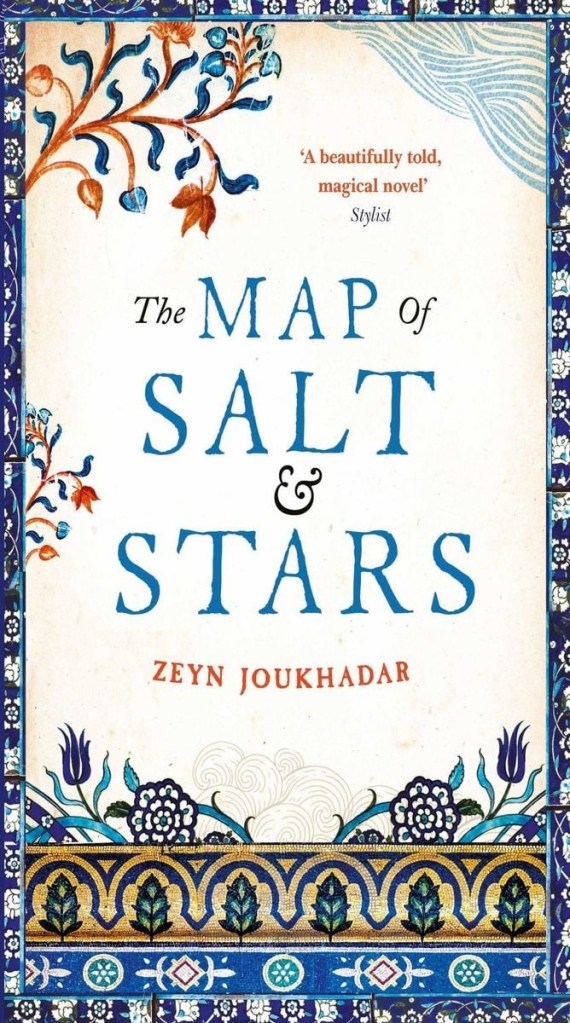
The Map of Salt and Stars

Unrest in Syria began on 15th March, 2011 as part of the wider 2011 Arab spring protests out of discontent with the Syrian government, eventually leading to an armed conflict. The war is currently fought by several factions. The Syrian Civil War is second deadliest conflict of the 21st century after the Second Congo War. The conflict has caused a major refugee crisis with millions fleeing to neighbouring countries (source Wikipedia). This book by Syrian American author, Zeyn Joukhadar, is rooted in Syria and celebrates it with a double tale of voyage and exile. The first tale is about 16 year old Rawiya, set in 12th century, who leaves her house in Benzu, near Ceuta (Ceuta is a Spanish autonomous city on the north coast of Africa), in search of adventure and with a quest to explore the world beyond the desert. She becomes an apprentice with the renowned explorer and mapmaker al-Idrisi and sets out on this perilous and unforeseeable odyssey to assist al-Idrisi in sketching the map through the Maghreb and the Mediterranean. During this adventure of a lifetime, she comes across blood thirsty mystical creatures; vicious men; cruel, tyrant kings and their armies; and difficult terrain and weather. This only establishes Rawiya as a gallant warrior. Rawiya single handedly helps al-Idrisi in completing his exploration of the world whilst constantly battling attackers and reminding everyone through this pursuit that her gender is no barrier in achieving accolades and appreciation and in being one of the greatest warriors of her time.

The second tale is of the present day, 12 year old Nour who has moved to Homs in Syria from Manhattan after her father’s death; with her mother, who is a mapmaker and two sisters, Zahra and Huda. As she is adjusting to her new life in Syria while knowing only a few words of Arabic, she is now one amongst many who has got trapped in the Civil war. She experiences bombing of her house and from there on, her ordeal for survival begins. Instantly her status becomes that of a refugee as she manages to escape from Syria. She has to let go of her mother and sister Huda during this gut wrenching journey which takes her through Jordan, Libya, Algeria and finally to Ceuta. The tale is as much a portrayal of Nour’s resilience, as much as it is, about her coming to terms with the menacing traits of human behaviour and the rot that has crept into humanity at large.

The narrative constantly flips between the stories of Rawiya and Nour. It’s a slow paced read. Islamic history and ancient names of cities find a constant mention through the book. I had to refer to Google lot many times to educate myself about the same. The author brilliantly depicts the striking geographical similarities between the old world and the current. Maps form an integral part of the storyline throughout the book. There are constant references about stars, galaxies and various constellations. I did find Nour’s narrative a bit tedious, since it gets a lot metaphorical at times. It isn’t an easy book to read. How would it even be? How can any book that talks about a devastating civil war be pleasant in any way? The author deftly portrays the geopolitical dissimilarity in tales of Rawiya and Nour. Rawiya’s is about bringing the world together by sketching the map and defining the borders, whilst ironically in Nour’s, it’s about a disintegrated world and the battles at the borders.

~ JUST A GAY BOY. 😞