

📍South Korea 🇰🇷
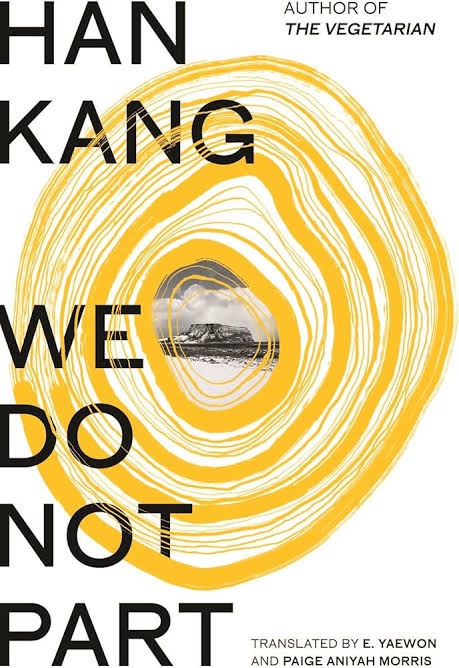
When Han Kang writes you dissolve and absolve; you assimilate and disintegrate; you discombobulate, yet transcend and transform. She writes so that we can feel the pain; she writes so that we can be bruised; she writes so that we can be healed. Her literature is enigmatic; brimming with incomprehensible and incongruent complexities which when mulled over reverberates, retaliates and reveals its naïveté and nuance. We Do Not Part is a summation of Kang’s ingenuity and humility in harnessing language to create a story that is literally haunting and sublime in equal measure.
Kyungha is having a miserable time bracing the sweltering heat of Seoul. She is simultaneously questioning her life’s choices and purpose, whilst being a recluse and starving herself. She reminisces and contemplates the changing dynamics of her relationship with her friend Inseon, a former documentarian, who now resides in Jeju island working as a carpenter and having her own studio. As the blistering summer gives way to chilly winter, Kyungha receives a frantic call from Inseon who is now hospitalised in Seoul following an accident. When Kyungha goes to visit her, learns about her medical predicament and observes the gruesome treatment being carried out; Inseon requests her to go to her home in Jeju island to feed her bird who has now been without any food or water since Inseon’s admission, hence could die anytime. Kyungha reluctantly proceeds on this arduous journey to Jeju in the midst of a severe blizzard probably thinking that saving the bird is her purpose. The blizzard is so extreme and violent that travel and communication become a nightmare. As Kyungha trudges through snow covered lonesome and terrifying terrain, enveloped in biting cold and formidable darkness, she falls, gets hurt, loses consciousness, wonders about an impending frostbite, and finally reaches Inseon’s house, only to find the bird dead.
With the relentless snowstorm and an ominous tenebrosity, Kyungha tries to make sense of her onerous journey while feeling marooned and helpless. Suddenly she finds Inseon in the house and it appears to her as if Inseon had been here all the while. As she is examining the impossibility of the current moment, and the possibility of her death, and all this being a subconscious spectacle or an apparition trick being played by her dying mind; Inseon starts narrating her story, why Jeju is so close to her heart and why has she chosen to be here despite it being far away from the mainland. She then recounts the horrendous Jeju massacre of 1948 through newspaper articles and old photographs wherein 30000 islanders were killed. Inseon highlights her mother, Jeongsim’s fight for justice who pressurises the authorities for an investigation, mobilises the aggrieved communities together to start a movement for identifying the victims that were killed and buried. Through this exercise, her mother hoped to heal her own loss that she and her family endured during the massacre and expected closure to an ambivalent grief.
The three protagonists are the most unassuming, ordinary women who are weak and apathetic in many mundane scenarios but assuming stoicism and steely grit in extraordinary circumstances. Kyungha’s unwavering determination to reach Inseon’s house as she wades through knee deep snow in a no mans land, is of epic proportions. Inseon through her craft and values wants people to know the anguish her family and the islanders at large suffered in the massacre. Inseon’s mother, who becomes a postmemory in the narrative, embodies vulnerability in all its glory. She shows how vulnerability is a strength to reckon with. She demonstrates perseverance in the most punitive of circumstances. But the beauty of Han Kang’s three women, is their willingness and ability to confront cataclysm and catastrophe singularly, hence bringing plurality to the multidimensional multiverse that is womanhood. There are two other unlikely characters in the book; snow and flame. For the greater part of the book, the sinister snow keeps the characters and the readers almost in a chokehold. It’s merciless, icy, unyielding that is meant to suffocate. Then there’s flame, who is trying to provide a respite from the foreboding, yet the shadows that it brings in its wake intermingle with the prevailing doom.
We Do Not Part is a shapeshifter. Scorching, sultry Seoul shifts into arctic Jeju. The narrative voice keeps shifting from Kyungha and Inseon; the women themselves shift from torpidity to vitality, from aggression to acquiescence. The story shifts between life and death effortlessly. Han Kang begins the story languidly, suddenly making it breathless and claustrophobic and decelerates just for a moment before introducing us to the historical carnage that ripped apart people and a peninsula. She wants us to gasp, squirm, question and feel uncomfortable. This is literature that is porous to humanity’s evils, disregards pragmatism and polity, and intends to induce a paralysis of hope.
The Jeju massacre started as an uprising on Jeju island in April 1948 till May 1949. In the aftermath of World War Two, the newly liberated Korean Peninsula was emerging from Japanese colonisation (1910-1945), and Koreans were determined to develop a unified nation. Three months after the Japanese were ousted, a new occupying force, the USA, arrived on Jeju. On Jeju, opposition to a divided Korea was strong. At the heart of the incident was widespread opposition to US supported election that would create a separate Korean government in the south, dividing it from the north. The US was concerned about Jeju becoming a “red island”. The left wing groups were crushed, police brutality increased leading to a thirst of vengeance among police, military and people’s committees on both the left and the right. What followed was violence, deaths, displacement and destruction of some 300 villages. Some of Jeju’s most popular tourist attractions today were the site of civilian massacres. Ultimately, a south only government was formed, the Republic of Korea, headed by US backed President. The fallout of this was the Korean War from 1950-53 between North Korea and South Korea that ended up having 3 million civilian deaths and 2 million civilian casualties.
We Do Not Part is a necessity as it exposes a forgotten, rather undisclosed part of history. e. yaewon and Paige Aniyah Morris have done the herculean task of translating Kang’s intricate and devastating prose from Korean to English. History has always been written by people in power. Majority of the history that we have been made to know is essentially a history that is whitewashed, with little to no reference of the colonised people and the atrocities committed to them, and it’s a history that forever exonerates the colonisers. Han Kang has taken the reigns to enlighten us about her Korean history as it happened and is demanding answers. Her prose shows us how memory outlasts violence. Sometimes, literature is supposed to trigger, to shame and to call out the so called powerful for their inherent perfidiousness. Kang’s literature does that.
~ JUST A GAY BOY. ✨

 the shiny diaries