

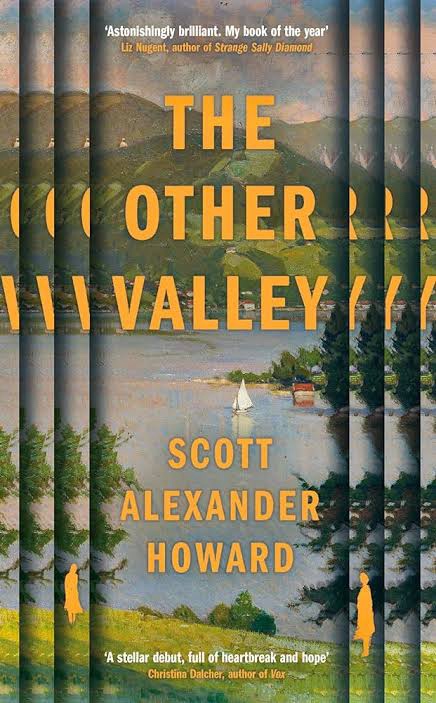
Odile Ozanne lives in a small town which is actually a valley, surrounded by mountains and barbed wire borders. To her right is the same town twenty years into the future. To her left is the same town twenty years into the past. And the valleys keep repeating on either side. The movement between these towns and essentially through time is strictly controlled by the Conseil who invite and review petitions from people who wish to travel to the east or west. The borders are also patrolled by the patrol guards, gendarmerie. The book begins with sixteen year old Odile trying hard to get through the vetting program for being a member of the Conseil. Her intelligence shines through the vetting process and she starts getting noticed by the more popular kids from the school. She starts hanging out with them and develops feelings for one of the boys, Edme. But one day she notices people from afar, looking like Edme’s parents, but older, arousing a suspicion in her that they maybe visiting from the east or Est 1, which also means that there is a strong likelihood of something terrible happening to Edme. What does Odile do next?
The second part of the book introduces us to thirty six year old Odile. A lot has happened and she finds herself in a thankless job, a job that she does in an autopilot mode. The relationship with her mother is distraught, her friendships seem ambiguous and loneliness seems to be her only steadfast companion. Circumstances hit the proverbial rock bottom and Odile decides to do the unimaginable prompted by strong emotions from her past.
The Canadian author, Scott Alexander Howard, takes us on this science fiction, time travel story which is unlike any other. People in the story do not hop across timelines and the author explains the protocols for doing so in the right way and the consequences when not done correctly. I had a difficult time trying to orient myself to the organisation of the valleys and imagining how would Odile’s world actually look like. Time in this book is never absolute but always relative to the other valley. A lot of the narrative is spent on Odile’s internal struggles and her going about the mundane. Very little happens in the book, especially in the second part. The writing is tedious particularly when the author talks about the valleys and the time zones. He never spells it out completely and for the most part it becomes a guessing game. Also the protagonist Odile comes across as unlikeable due to her brooding and one dimensional persona and at times appears inconsequential to the story. None of the other characters make an impact either.
The Other Valley is a very unique story and kudos to the author for writing this as his debut work. I tried very hard to love this book but all through I felt shortchanged. Not that I dislike it or wouldn’t recommend it but the book could have been taut with some much needed edits. Despite my grudges, I would still call it a complex and cerebral read.
~ JUST A GAY BOY. 🥸



 the shiny diaries