

📍 Suriname 🇸🇷
Bee Vanta is sick and she knows she’s dying. She is the matriarch of her large estranged family and has been disappointed with everyone’s life choices. She, a white Dutch woman married a Black man, Anton, who served in the military. Winston, the apple of her eye, abandons her and goes off to the Netherlands, and establishes a life there with his partner Lya, never to return. Louise, her daughter, has four children, Heli, Imker, Babs and Audi, from different men, and has difficulty in sustaining relationships with men because of the cycles of exploitation and abuse. Laura, her other daughter, suffers a psychological collapse after her partner’s deception and now resides in an asylum. Rogier, her last son, is a doctor in the Netherlands, who left Bee and Suriname for a better life. Bee suffers the biggest setback when her favourite granddaughter, Heli, also decides to go to the Netherlands to pursue her dreams. Imker takes it upon herself to care for her grandmother and decides to live with Bee and tends to her with utmost love and affection, cooking for her, cleaning the house and even bathing her. As Bee navigates her distraught relationships both in memory and in person, she struggles to accept the crumbling dynamics of her family, the love which seems distant and unattainable, and she questions everything that has led her to this day, her decisions and mistakes including a secret, a dark and ruthless chapter of her life, that has cost her equanimity and composure leading to a permanent fissure within her heart.
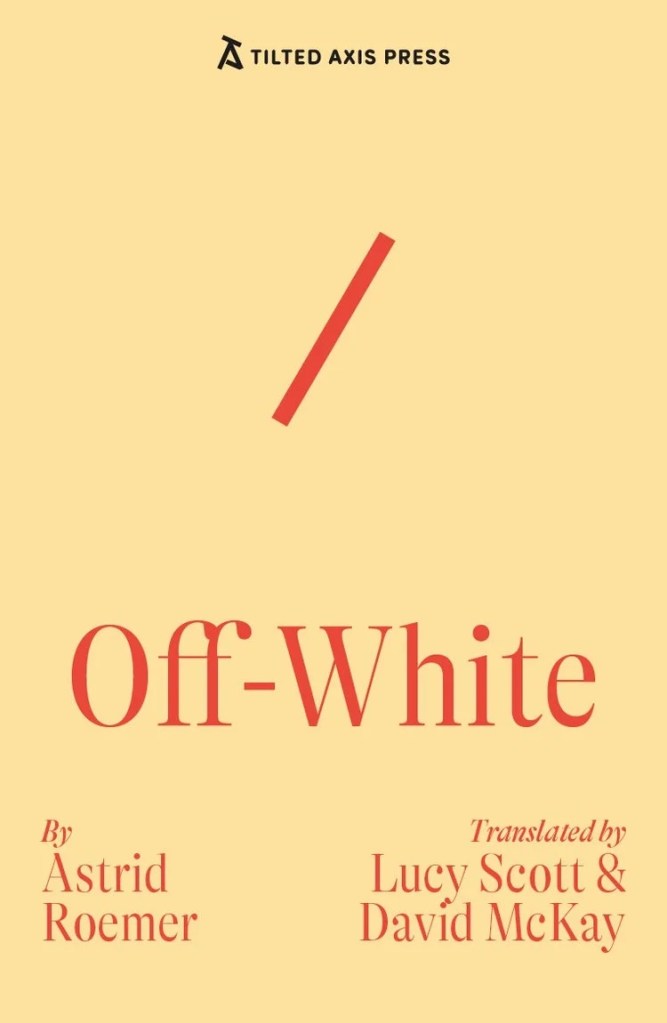
Off-White is a story that is embroiled in the familial interpersonal relationships and unresolved conflicts, differences and heartaches. The various mother-daughter relationships which form the greater part of the narrative are shrouded in lethargic love, abysmal animosity and a conspicuous callousness. These women seem to carry the intergenerational traumas and a sense of repentance unbeknownst to them, struggling to understand its history, that has cast a spell on their present and that which is also threatening to ruin their future.
Bee hasn’t come to terms with Louise’s choices in life and doesn’t think highly about her. According to Bee, Louise’s inability to have a husband has been her downfall and hence the necessity for her promiscuity. Bee has also internalised Laura’s shame for being unstable and depressed. Louise tries to maintain a stoic facade when internally she remains fragile and fundamentally distracted. Her repeated attempts to seek companionship, despite countless betrayals, can seem as a call of defiance in the times of hopelessness, but simultaneously it also portrays her adamancy in embracing solitude. Heli, though charted her own escape from the confines and traps of an overbearing and dysfunctional family, is unable to resist the melancholy that it has brought in its wake. She is also juggling a strangely toxic relationship with a married man, who is in Suriname while indulging in passionate encounters with another man in the Netherlands. This dichotomy and dishonesty claims her spirit and consciousness as she meanders through one questionable choice after another. Imker, seems to have intentionally decided to clean up the emotional mess of her family. Whilst caring for Bee, she chooses to distance herself from a maternal illusion and a sisterly loss. As she focuses on her two other siblings, she tries to objectively analyse the desolation that Louise and Heli have left in her life. Her relationship with a Muslim man, Umar, gives her perspective, possibility and permission to have wants and needs and somewhere during this journey she starts to find her personality.
Off-White is one of those demanding works of literature that has been written deliberately to unsettle you. It is controversial, convoluted and courageous. It hides the blasphemy in the whispers of secrecy and inconvenience. It is inconsistent, indelibly unconventional yet remains as a potent offering of love, compassion and forgiveness. The book explores dysfunctional relationships and dissects its origins and decay. The narrative sensitively captures the sexual exploration, experience and exploitation of the various women characters. The sexuality is boldly infinite, the sexual violence squeamish and shocking. The book also delves into the politics of colourism and racism and how skin colour can influence kinship and familial ties. The title of the book, Off-White, is in fact rather symbolic and almost feels like a scathing critique on the racial inadequacies of the society at large.
The characters in the book provoke you as a reader, compel you to submit to their chosen adversities, to accept their misfortunes and mindless perversity. At the same time, they exhibit catharsis through their flaws and friction. The daughters and granddaughters of Bee seem to be acting as a receptacle of her maternal malevolence and benevolence, as Bee continues to self-flagellate for her prejudices and pride. This trickles down through the progeny as her children and grandchildren inherit the same tendencies and continue to lead lives that can only be described as off-colour.
Astrid Roemer, is a Surinamese Dutch writer and teacher, and the first Caribbean author to win the P.C. Hooft Award (a Dutch-language literary lifetime achievement award) in 2016. In 2021, she received the Prijs der Nederlandse Letteren (the most prestigious literary award in the Dutch speaking world, awarded every three years) becoming the first Surinamese winner. Her book, On A Woman’s Madness, first published in Dutch in 1982, was translated into English and published in February 2023. In September 2023, it was longlisted for the National Book Award for Translated Literature, and in 2025 was longlisted for the International Booker Prize. Off-White, was first published in Dutch in 2019, and its English translation was published in 2024. The translators, Lucy Scott and David McKay, have done a prodigious job in translating this monumental work of Roemer.
Astrid Roemer is a tour de force in the world of literature. Her writing is problematic, poignant and purposeful. She writes to explore the endless possibilities of living and existing. Suriname is the soul of Off-White as she takes us on a geographical journey from Paramaribo to Nieuw Nickerie. The story is Surinamese in its entirety and Roemer hasn’t made any concessions or given any explanations for people who aren’t Surinamese or familiar with the country. The colonial history of Suriname is the silent subtext that courses through every page in the book. The language is piercing and punishing in equal measure. Roemer’s Off-White is an affirmation of the fact that a book can be a masterclass in storytelling and a masterpiece of literature while retaining its integrity and authenticity.
If Han Kang illuminated the fragility of the human condition, Astrid Roemer exposes its fractures with equal brilliance. Having said that, I think I have a new favourite.
~ JUST A GAY BOY. 👏👏

 the shiny diaries