Behind You Is The Sea

The book is a collection of stories by Palestinian Americans living in Baltimore. Each chapter is dedicated to a different character and as you read along, you realise all of these characters and their families are interconnected. 

With this book, the author, Susan Muaddi Darraj, has tried to reflect upon the intergenerational chasm that exists inevitably and yet how the various generations are inextricably linked. Though Palestinian heritage is the commonality, the newer generations are more American than Palestinian in their personalities and perspectives. This remains the bone of contention among the older folks who are unable to make peace with their diasporic status and are torn living a life that oscillates between reminiscences and resentments. 

The book also tackles some serious issues that plague the Palestinian society such as honour killing, patriarchy, chauvinism, domestic violence and misogyny. Women are expected to be subservient to men, regardless of their achievements. The chapter in which a father is disgruntled and disowns his daughter for having an abortion sans marriage and having a Black boyfriend is unnerving. The chapter wherein a mother constantly chastises one of her professionally successful daughters for being divorced and not having children in comparison to her other daughter who is married and has numerous children, speaks highly about internalised patriarchy. Only the last chapter takes place in Palestine, when one of the characters is forced to bring his father’s corpse to Palestine for burial as per his last wish. What was supposed to be a solemn event, turns into an emotionally frustrating exercise when the son learns the benevolent side to his father’s personality, especially when not even an iota of that benevolence was ever bestowed upon him or his sister. 

Susan Muaddi Darraj is a Palestinian American writer who has authored several collections of fiction, young adult and children’s books. She is the recipient of various awards; winning the Arab American Book award in 2021 and 2016 for Farah Rocks and A Curious Land, respectively. A Curious Land was also shortlisted for Palestine Book Award. 

Behind You Is The Sea, my pick for Arablit April, was a unique reading experience for me because this was the first Palestinian book that I have read, (and I have read a few!) that spoke about Palestinian Christian families compared to the majority of Palestinian literature that is about Palestinian Arabs. Palestinian Christians form a sizeable minority in Palestine and the book helped me understand the inseparability and intertwining of Christian and Arab cultures. 

Now, almost all of the social ills highlighted in this book are inherently prevalent in our Indian society. This goes to show that Indians and Palestinians are not very different because we were all colonised people and carry the repercussions of the British colonisation and occupation through generations. Having said that, it doesn’t mean we continue to have these colonial hangovers till today. Yet somehow, the general Indian population now supports Israel, a current day coloniser, who has mercilessly and relentlessly continued the genocide in Gaza since October 7, 2023. Have we forgotten our own history or has the prevailing Islamophobic jingoism made us all intellectually bankrupt commentators?

~ JUST A GAY BOY. 🍉

Gaza Weddings

Life in Gaza is unpredictable. Hope and desire is fickle too. So what does it take to plan a wedding in Gaza then? Ibrahim Nasrallah’s book talks about the irony of having a wedding in the midst of bombs and death. He uses dark humour, sarcasm and stark realism to convey the misery and hopelessness that abound life for Gazans. Through the two protagonists, Amna and Randa, the book provides a cataclysmic account of Palestinians in Gaza under the Israeli occupation.

Randa, is an aspiring journalist, who’s identical twin sister, Lamis is in a courtship with Amna’s son Saleh. In the book, Amna keeps talking to her husband who’s in hiding while Randa talks to the readers directly. Death is so commonplace in Gaza that no family is unknown to its horrors and the brutality of the occupation. Amna is bereft after she hears about the suspected death of her husband but is unable to identify him since it’s so badly disfigured. Saleh is unable to process his father’s martyrdom and becomes emotionally unstable. Towards the end, the story depicts the death of one of the twin sisters. We never know who is dead.

Ibrahim’s writing is part lyrical, part biting. Death, tears and sadness form the canvas on which he paints the precarious lives of Palestinians. Bittersweet reminiscences and pervasive foreboding become everyday nuances for Amna and Randa. Joy and laughter feel misplaced and unnatural when there’s grief lurking at every turn. Ibrahim Nasrallah is a Palestinian writer, poet, artist and photographer with an extensive body of work and has been the winner of the Arabic Booker Prize in 2018. The book has been translated into English by Nancy Roberts who is known for her translations of Arabic literature.

As of 13th March, 2024, 31,200 Palestinians have been killed in Gaza and more than 72,800 have been injured since Israel began the genocide on October 7th, 2023. There’s no life in Gaza literally. Those who have survived the bombs and Israel’s ethnic cleansing, are now starving to death. The current day Holocaust is going unchecked and unabated as the world continues to look the other way. How are we ever going to face ourselves in the future? For how many years will Israel and its comrades, especially the United States, will have to beg for forgiveness? Should they ever be forgiven then?

~ JUST A GAY BOY. 😞

This Arab is Queer

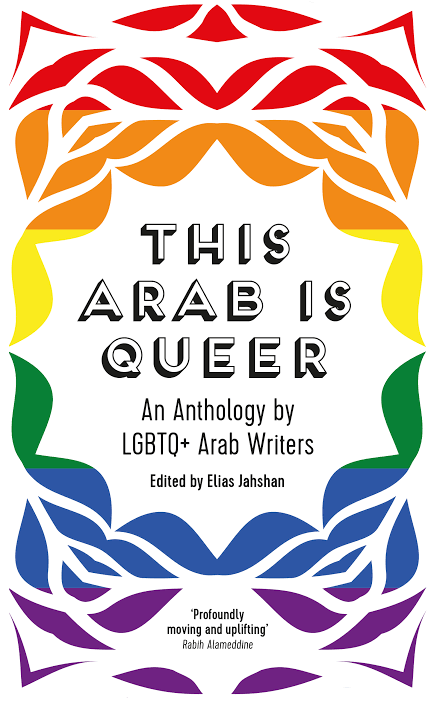
I feel, I am blessed to have read this book, that too during pride month. The book, which the Time magazine hailed as ‘groundbreaking’, is indeed that. It’s also trailblazing in so many ways. It’s an anthology of 18 essays written by queer Arab writers from the SWANA region, edited by Elias Jahshan, a Palestinian Lebanese journalist living in Australia. Now when was the last time you heard or saw space for a queer arab? And that’s the power this book yields. By asking 18 brilliant writers to write their stories, their way, many through their lived experiences, this book embodies the queer arab narrative, emboldens the queer arab and makes their visibility and intersectionality a necessity. While the stories are rooted in the arab-ness and queerness, diaspora or otherwise, the feelings of dignity, safety, and belongingness remain universal.

The book begins with the feminist giant (that’s also her newsletter) Mona Eltahawy’s essay, The decade of saying all that I could not say. Mona, a survivor of sexual assault, has been a crusader against patriarchy. In her essay she astutely describes her reckoning of owning her sexuality, her bisexuality, and the umpteen nuances that make it so. Her liberation by shedding the shame surrounding sex, has been an act of rebellion. As a Muslim woman, her vehement uprising against heteronormativity has been her emancipation. Mona writes not just to inspire us but to instigate our power.

Though each essay is profound, I would like to highlight a few that stayed with me. Amrou Al-kadhi’s essay, You made me your Monster, is a fierce, defiant take on Arab-ness, Quran and his Islamic identity. His transgressions viewed as blasphemous in the Arab world are just his ways of honouring his own authentic existence. Through his flamboyant, glamorous drag persona, Glamrou; Amrou is reinforcing the power in provocation.

Danny Ramadan, in his essay, The Artist’s portrait of a marginalised man, talks about how his writing is always up for debate, whether it’s fiction or non fiction and if it’s based on his real life experiences, simply because he’s a queer Syrian man with a refugee experience. He poignantly points out people’s assumptions about him and his work since he’s a queer arab and also worries if his real life trauma is going to unknowingly and inadvertently slip into his every narrative.

Amna Ali’s essay, My intersectionality was my biggest bully, is an eye opening piece about her journey as a Black Queer Arab. Growing up as and being a visibly Black person in a racism predominant society like UAE, Amna had a tumultuous upbringing wherein she was taught to be shameful about her blackness. Later, she became shameful about her queerness too. This amalgamation of multiple identities made her distraught, caused her abuse and violence, until she learnt to make peace with them. Amna has since realised her intersectionality as a Somali-Yemeni-Emirati queer person, is her true strength and yet it continues to be an arduous journey.

Hasan Namir’s story, Dancing like Sherihan, is about his tryst with shame due to his queerness leading to his ingrained belief about him being a sinner. His strict Iraqi Muslim upbringing was always at odds despite him moving to Canada and experiencing queer freedom. His essay deftly portrays the internal struggles of a queer person as they oscillate between religious virtues, familial pressures, internalised shame and queer trauma. Hasan’s relationship with Tarn, leading to their marriage and later having a child is one that of queer joy. It makes you misty-eyed, it makes you hopeful and it feels like a collective queer victory.

Madian Al Jazerah’s moving piece, Then came Hope, is an ode to him as a displaced Palestinian Queer man who is constantly engaged in an embittered battle with shame whilst remaining hopeful that he would emerge triumphant. His trauma is multilayered as he navigates zionism and homophobia. His astute observations on the blatant yet veiled discrimination in the gay world is one that many of us can identify with. Madian has a beautiful bookstore in Amman which I had visited back in 2019. It’s now through this book that I know the connection between the bookstore and him and have been so ecstatic since. Queer joy indeed comes in so many forms and experiences. I would like to quote a couple of lines from his essay which I felt were earth shatteringly brilliant. Here goes;

I know from experience that you can put shame on the highest shelf and forget about it for a while, but bigots and bullies can smell it and it is always within their reach.

When we talk about love, the image of a heterosexual couple is accompanied by a thousand positive romantic associations. When we talk about gay men, the image is of two men having sex.’

Many or most of these stories are about shame and trauma, and that’s so true since those are the first feelings one experiences as a queer person. They also highlight the yearning for love, acceptance and inclusion. These stories are a lot tragic, which just goes on to show the commonality in their lived experiences as a queer arab. At the same time, the writers have done a commendable job in instilling faith and hope despite their grim realities of being a queer arab in a world so hostile towards them. This is a book that is going to jolt you out of your assumptions, privileges and entitlements. Burst that bubble, it’s time for a masterclass on humility and humanity.

Elias Jahshan has done beyond stellar work as an editor. Bringing together each of these supremely talented and gifted writers is not just groundbreaking but distinctively exceptional. Take a bow!

~ JUST A QUEER HUMAN. 🥹🥲

The Bride of Amman

📍Jordan 🇯🇴

This debut novel by the Jordanian writer, Fadi Zaghmout, originally written in Arabic (Aroos Amman), later translated into English by Ruth Ahmedzai Kemp, caused quite a stir when it was released. Understandably so, considering the bold and controversial issues it explores, which are often deemed taboo and blasphemous in the traditional Jordanian society. The story is told through five characters of Leila, Salma, Rana, Hayat and Ali; all living in the capital city, Amman. Through these stories, the author tackles the persistent and pertinent issues of patriarchy, misogyny, chauvinism, incest, rape, sexual abuse, homophobia, widely prevalent in the conservative Arab community. An Arab woman’s worth is equated with her ability to get married at the right age, be a dazzling bride and bear children, especially sons. Her career and education are just an ornament. Zaghmout repeatedly asserts how women have no authority or agency over their own lives and bodies, and their choices are subject to male dominance and approval. Particularly disturbing story is that of Hayat, who is raped and sexually abused by her own father; later chooses promiscuity with multiple married men to escape this horrid truth.

Zaghmout’s narrative is a poignant reflection of contemporary Amman, however, I felt, that at many instances, he has tried to infantilise the grave problems. Hayat, as a rape survivor, is shown to forgive her father for his unpardonable crime. Her choice of being promiscuous seems to be very flippant and it seems as the only way a woman can get over her sexual abuse past. Ali, a closeted Iraqi gay man, gets married to Leila, has a child, and continues to have gay sexual encounters on the sly. Leila later discovers his homosexuality and upon confrontation, chooses to accept her life as his wife, devoid of sex, delves steadfast into her career and turns a blind eye to his indiscretions. In the book, the men are forever exonerated for their crimes and wrongdoings, by the women. There’s always some “logical” reasoning to the way the men have behaved. This almost invisible, subtextual chauvinism can’t be ignored. Also, other than Salma’s story, the others seem to have the proverbial happy ending. This smacks of immature writing.

Majority of Indian gay men remain closeted and continue to have heterosexual marriages and children under the pretext of parental pressure and culture. They also have multiple gay liaisons after marriage with gay abandon (no pun intended) and literally no remorse. Are the Indian women too, like Leila, choosing to not see the obvious because of the pressure to stay married and the stigma of divorce? Or are they truly oblivious?

Though the book is about Ammani women, one can’t miss the fact, how close this hits home. Indian women, are still governed by the cis men around them, and it remains an ongoing struggle for them to establish their equality and agency.

~ JUST A GAY MAN. 🥺