

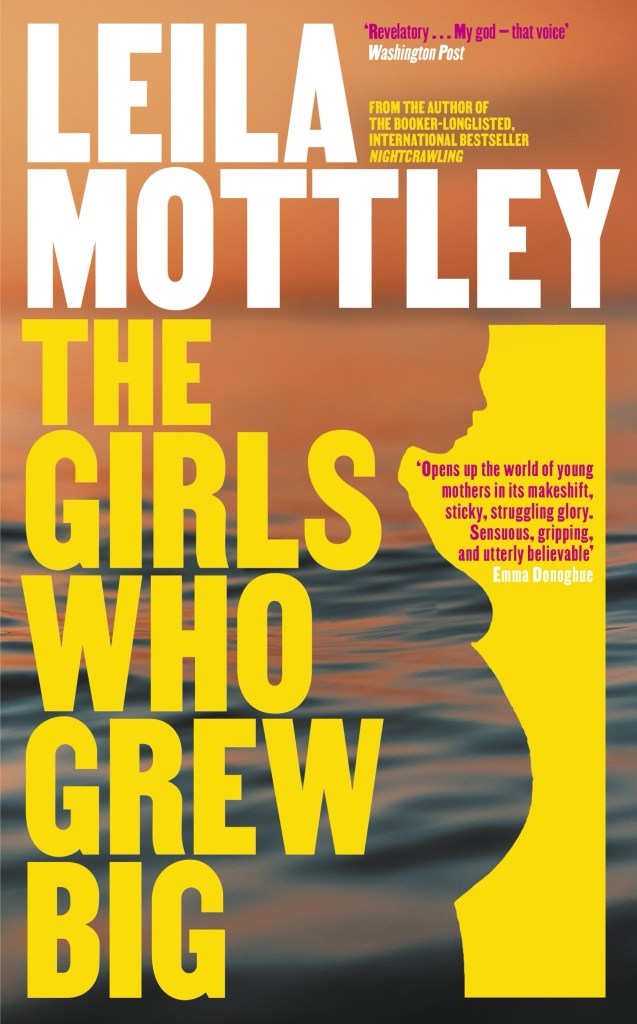
Leila Mottley’s second outing has grown bigger in terms of its stature, calibre, characterisation and language. Her first book, Nightcrawling, confronted racism, police brutality, vulnerability and poverty; The Girls Who Grew Big tackles the uncomfortable realities of teenage pregnancy and the familial and societal ostracism that accompany it, all set against the backdrop of eroding reproductive rights and restricted abortion access in contemporary America.
Set in the beach town of Padua, in the Florida panhandle, the story is about a group of young teenage girls banding together as they face rejection, ridicule and discrimination for being pregnant. Calling themselves ‘The Girls’, they find a sense of community, safety and emotional security through this sisterhood. Among them, the author principally focuses on three protagonists: Simone, Emory and Adela.
Simone, the eldest at twenty, is raising her twins, Luck and Lion. Their father is a wayward, irresponsible guy called Tooth with whom she tries to maintain civility for the sake of her children, despite the disgust she feels for him. When she discovers she’s pregnant again, her desperate attempts to find a safe abortion lays bare the grim realities of reproductive inequity in America today.
Emory, a white girl disowned by her family for getting pregnant with a Black guy, finds solace with the Girls. She comes to live with her grandparents who aren’t the most welcoming of her or her situation. The constant rebuke, revulsion and mistreatment that she experiences at her grandparents’ home makes her determined to complete her education despite the odds. After she gives birth to Kai, her vulnerability coupled with maternal guilt makes her reconsider her earlier choice and instead she decides on marrying the father of her child when he proposes to her, though she is now in love with another girl. The emotional chaos paves the way to a penultimate moment that is singularly powerful and unconventionally self-affirming that forms the emotional heart of her narrative.
Adela, who comes from a privileged background, is sent away from Indianapolis to Padua by her conservative, devout parents to stay with her grandmother Noni, so that her pregnancy, which they consider an abomination, can continue in secrecy and after the delivery, she can come back to them sans the child and go back to living her original life of becoming the best swimmer in the country. After she meets Simone and Emory, her priorities start to shift and she starts enjoying their camaraderie. However, impulsive decisions and a string of reckless behaviours soon upend her life and her friendship with Simone and Emory, so much so that the three girls are forced to arrive at the thresholds of an emotional precipice that will reshape and realign their lives forever.
Simone, Emory and Adela represent the section of the society who are always shunned into oblivion for an occurrence that involved an equal contribution from a man. Their stories are a telling of the unprovoked patriarchy, chauvinism and misogyny that comes disguised as morality. Their standing in the face of social adversity that demands obscurity of them, which often gets labelled as resilience and courage, is in fact a mirror of the helplessness and humiliation bestowed upon them by the society at large. Simone nurtures her children and the other girls in spite of her dire financial and living circumstances, to build this sisterhood, which she knows is going to protect them all. Emory’s radical decision, which can be perceived as selfish and antithetical to motherhood, is essentially a defiant act of self compassion that speaks of her need to self actualise her reality, rather than be consumed by its consequences, hence reframing motherhood through the lens of autonomy. Adela’s necessity to build a falsified image of herself to gain affection is symbolic of the various ways in which patriarchy operates. She does reclaim her dignity through self acceptance, refuses to self flagellate, despite the retribution and continues to take accountability for her actions without letting them define her.
The Girls Who Grew Big, as a book, is an intricate, intimate portrait of pregnant teenage girls that doesn’t resort to sensationalism or melodrama. There is a quiet fortitude in its pages that gets revealed slowly and steadily. It’s a scathing commentary on the circumstantial evolution of motherhood from romanticism to ostracism, invisibility to hypervisibility, pride to shame. Leila Mottley has proven once again that she is a master storyteller and a gifted writer, and one who can navigate the most complex human emotions and experiences with the needed attention and affirmation. If Nightcrawling demanded a brutal urgency, then this book requires and delivers, patience and tenderness, empathy and nuance. Mottley, through her ingenious writing, has kept sisterhood as the overarching theme, and hasn’t reduced it to a trope or made it synonymous with toxic positivity. Instead, she has shown sisterhood to be a living, shifting force, that can empower, protect and ultimately redeem.
As the girls grow, physically, emotionally and spiritually, so too does Mottley, cementing The Girls Who Grew Big as a work of remarkable maturity and depth.
~ JUST A GAY BOY. 😇
 the shiny diaries