
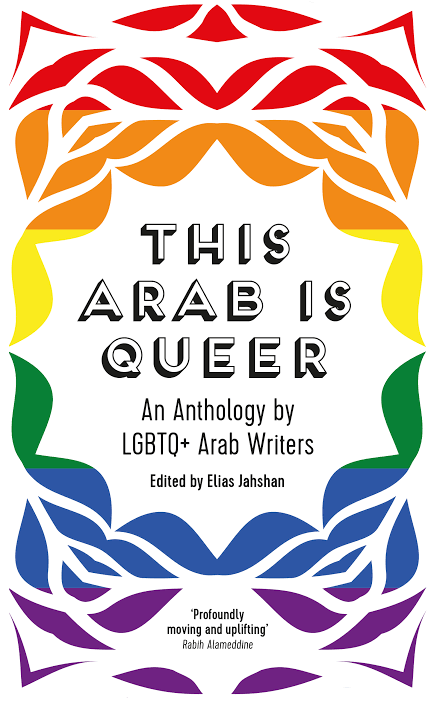
This Arab is Queer

I feel, I am blessed to have read this book, that too during pride month. The book, which the Time magazine hailed as ‘groundbreaking’, is indeed that. It’s also trailblazing in so many ways. It’s an anthology of 18 essays written by queer Arab writers from the SWANA region, edited by Elias Jahshan, a Palestinian Lebanese journalist living in Australia. Now when was the last time you heard or saw space for a queer arab? And that’s the power this book yields. By asking 18 brilliant writers to write their stories, their way, many through their lived experiences, this book embodies the queer arab narrative, emboldens the queer arab and makes their visibility and intersectionality a necessity. While the stories are rooted in the arab-ness and queerness, diaspora or otherwise, the feelings of dignity, safety, and belongingness remain universal.

The book begins with the feminist giant (that’s also her newsletter) Mona Eltahawy’s essay, The decade of saying all that I could not say. Mona, a survivor of sexual assault, has been a crusader against patriarchy. In her essay she astutely describes her reckoning of owning her sexuality, her bisexuality, and the umpteen nuances that make it so. Her liberation by shedding the shame surrounding sex, has been an act of rebellion. As a Muslim woman, her vehement uprising against heteronormativity has been her emancipation. Mona writes not just to inspire us but to instigate our power.

Though each essay is profound, I would like to highlight a few that stayed with me. Amrou Al-kadhi’s essay, You made me your Monster, is a fierce, defiant take on Arab-ness, Quran and his Islamic identity. His transgressions viewed as blasphemous in the Arab world are just his ways of honouring his own authentic existence. Through his flamboyant, glamorous drag persona, Glamrou; Amrou is reinforcing the power in provocation.

Danny Ramadan, in his essay, The Artist’s portrait of a marginalised man, talks about how his writing is always up for debate, whether it’s fiction or non fiction and if it’s based on his real life experiences, simply because he’s a queer Syrian man with a refugee experience. He poignantly points out people’s assumptions about him and his work since he’s a queer arab and also worries if his real life trauma is going to unknowingly and inadvertently slip into his every narrative.

Amna Ali’s essay, My intersectionality was my biggest bully, is an eye opening piece about her journey as a Black Queer Arab. Growing up as and being a visibly Black person in a racism predominant society like UAE, Amna had a tumultuous upbringing wherein she was taught to be shameful about her blackness. Later, she became shameful about her queerness too. This amalgamation of multiple identities made her distraught, caused her abuse and violence, until she learnt to make peace with them. Amna has since realised her intersectionality as a Somali-Yemeni-Emirati queer person, is her true strength and yet it continues to be an arduous journey.

Hasan Namir’s story, Dancing like Sherihan, is about his tryst with shame due to his queerness leading to his ingrained belief about him being a sinner. His strict Iraqi Muslim upbringing was always at odds despite him moving to Canada and experiencing queer freedom. His essay deftly portrays the internal struggles of a queer person as they oscillate between religious virtues, familial pressures, internalised shame and queer trauma. Hasan’s relationship with Tarn, leading to their marriage and later having a child is one that of queer joy. It makes you misty-eyed, it makes you hopeful and it feels like a collective queer victory.

Madian Al Jazerah’s moving piece, Then came Hope, is an ode to him as a displaced Palestinian Queer man who is constantly engaged in an embittered battle with shame whilst remaining hopeful that he would emerge triumphant. His trauma is multilayered as he navigates zionism and homophobia. His astute observations on the blatant yet veiled discrimination in the gay world is one that many of us can identify with. Madian has a beautiful bookstore in Amman which I had visited back in 2019. It’s now through this book that I know the connection between the bookstore and him and have been so ecstatic since. Queer joy indeed comes in so many forms and experiences. I would like to quote a couple of lines from his essay which I felt were earth shatteringly brilliant. Here goes;

I know from experience that you can put shame on the highest shelf and forget about it for a while, but bigots and bullies can smell it and it is always within their reach.

When we talk about love, the image of a heterosexual couple is accompanied by a thousand positive romantic associations. When we talk about gay men, the image is of two men having sex.’

Many or most of these stories are about shame and trauma, and that’s so true since those are the first feelings one experiences as a queer person. They also highlight the yearning for love, acceptance and inclusion. These stories are a lot tragic, which just goes on to show the commonality in their lived experiences as a queer arab. At the same time, the writers have done a commendable job in instilling faith and hope despite their grim realities of being a queer arab in a world so hostile towards them. This is a book that is going to jolt you out of your assumptions, privileges and entitlements. Burst that bubble, it’s time for a masterclass on humility and humanity.

Elias Jahshan has done beyond stellar work as an editor. Bringing together each of these supremely talented and gifted writers is not just groundbreaking but distinctively exceptional. Take a bow!

~ JUST A QUEER HUMAN. 🥹🥲
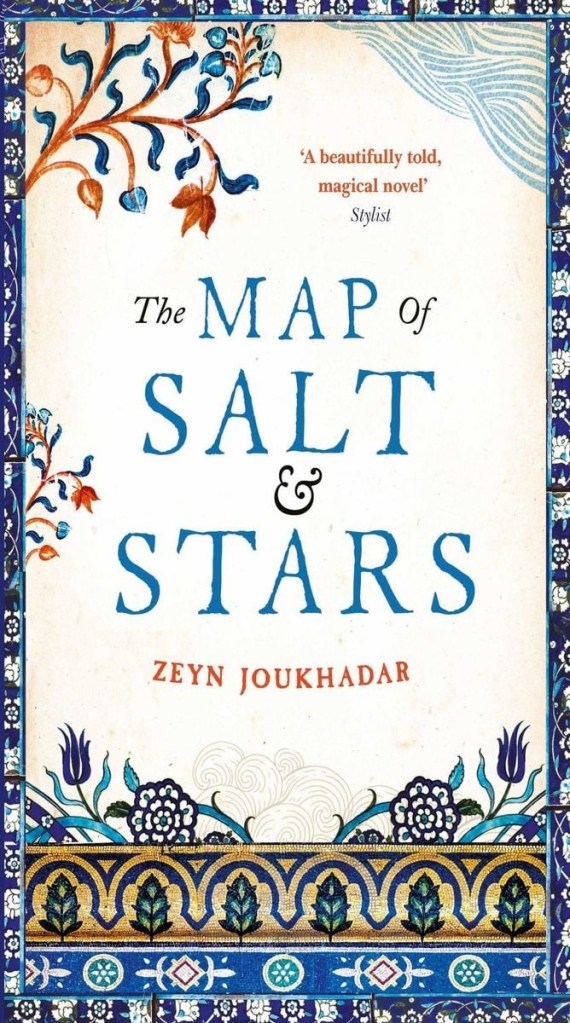
The Map of Salt and Stars

Unrest in Syria began on 15th March, 2011 as part of the wider 2011 Arab spring protests out of discontent with the Syrian government, eventually leading to an armed conflict. The war is currently fought by several factions. The Syrian Civil War is second deadliest conflict of the 21st century after the Second Congo War. The conflict has caused a major refugee crisis with millions fleeing to neighbouring countries (source Wikipedia). This book by Syrian American author, Zeyn Joukhadar, is rooted in Syria and celebrates it with a double tale of voyage and exile. The first tale is about 16 year old Rawiya, set in 12th century, who leaves her house in Benzu, near Ceuta (Ceuta is a Spanish autonomous city on the north coast of Africa), in search of adventure and with a quest to explore the world beyond the desert. She becomes an apprentice with the renowned explorer and mapmaker al-Idrisi and sets out on this perilous and unforeseeable odyssey to assist al-Idrisi in sketching the map through the Maghreb and the Mediterranean. During this adventure of a lifetime, she comes across blood thirsty mystical creatures; vicious men; cruel, tyrant kings and their armies; and difficult terrain and weather. This only establishes Rawiya as a gallant warrior. Rawiya single handedly helps al-Idrisi in completing his exploration of the world whilst constantly battling attackers and reminding everyone through this pursuit that her gender is no barrier in achieving accolades and appreciation and in being one of the greatest warriors of her time.

The second tale is of the present day, 12 year old Nour who has moved to Homs in Syria from Manhattan after her father’s death; with her mother, who is a mapmaker and two sisters, Zahra and Huda. As she is adjusting to her new life in Syria while knowing only a few words of Arabic, she is now one amongst many who has got trapped in the Civil war. She experiences bombing of her house and from there on, her ordeal for survival begins. Instantly her status becomes that of a refugee as she manages to escape from Syria. She has to let go of her mother and sister Huda during this gut wrenching journey which takes her through Jordan, Libya, Algeria and finally to Ceuta. The tale is as much a portrayal of Nour’s resilience, as much as it is, about her coming to terms with the menacing traits of human behaviour and the rot that has crept into humanity at large.

The narrative constantly flips between the stories of Rawiya and Nour. It’s a slow paced read. Islamic history and ancient names of cities find a constant mention through the book. I had to refer to Google lot many times to educate myself about the same. The author brilliantly depicts the striking geographical similarities between the old world and the current. Maps form an integral part of the storyline throughout the book. There are constant references about stars, galaxies and various constellations. I did find Nour’s narrative a bit tedious, since it gets a lot metaphorical at times. It isn’t an easy book to read. How would it even be? How can any book that talks about a devastating civil war be pleasant in any way? The author deftly portrays the geopolitical dissimilarity in tales of Rawiya and Nour. Rawiya’s is about bringing the world together by sketching the map and defining the borders, whilst ironically in Nour’s, it’s about a disintegrated world and the battles at the borders.

~ JUST A GAY BOY. 😞

Grey Bees

📍 Ukraine 🇺🇦

Andrey Kurkov, is a prolific Ukrainian author and independent thinker who writes in Russian. He is the author of 19 novels; the latest being Grey Bees, which has been translated by Boris Dralyuk. The story is about a middle aged, disabled pensioner and devoted beekeeper, Sergey Sergeyich, from the war torn region of Donbas in Eastern Ukraine. He is living in this three street village, Little Starhorodivka, along with its only other resident, Pashka, which falls in the grey zone, between the Ukrainian army on one side and the separatists supported by the Russians on the other side. Sergeyich has become accustomed to living without electricity; making do with whatever food is available. Bees are the only thing he truly cares for. Now with spring approaching, he needs to take the bees away from all the bombing and shelling happening in and around his village. As he sets off on this journey, which soon becomes an adventure, in the pursuit of providing his bees a secure environment, he lands in the Russian controlled territory of Crimea. His Interactions with a Crimean Tatar family whilst in the Crimean village of Albat, who provide him and his bees shelter, make the Russian officials suspicious of his intentions. Despite the bureaucratic surveillance on his activities, he takes it upon himself to help a young Tatar girl cross the Crimean border during the return journey to his home, in the grey zone.

Complex political decisions regarding geographical issues need not colour human emotions. The characters in the book have their humanity intact despite a ravaging war surrounding them. The author beautifully constructs their simple emotional arcs, at times peppering it with wry, dark humour. Kurkov takes times to build the narrative. He makes it atmospheric by indulging us in the mundane, boring yet terrifying life of Sergeyich. The moments at Border control and various checkpoints are so nerve racking, and described so viscerally, that you can feel Sergeyich’s anxiety and panic in you. That’s the brilliance of Kurkov. Through the characters of Aisylu and Bekir, he highlights the plight of the marginalised group of Crimean Tatars under the Russian regime, who are an indigenous people of Crimea. Not to forget, the honeybees are as much a central character in the book, as Sergeyich is. The author weaves in their life cycle, behaviour and discipline into the narrative in the most scientifically accurate and fascinating manner.

It’s evident that the whole of Ukraine has become a Donbas now. In a flash, citizens have become refugees. Because one day, a megalomaniac called Putin decided to assert his autocratic zealotry over the region. Not just Ukraine, there are so many countries (Yemen, Iraq, Syria, Afghanistan, Palestine) and regions (Tigray in Ethiopia) that are devastated by war. Wars have happened since time immemorial. Will this present war too become a piece of history for posterity? Or will we learn and strive to prevent such wars from happening again? Will we try to be humans first?

~ JUST A GAY BOY. 😓