

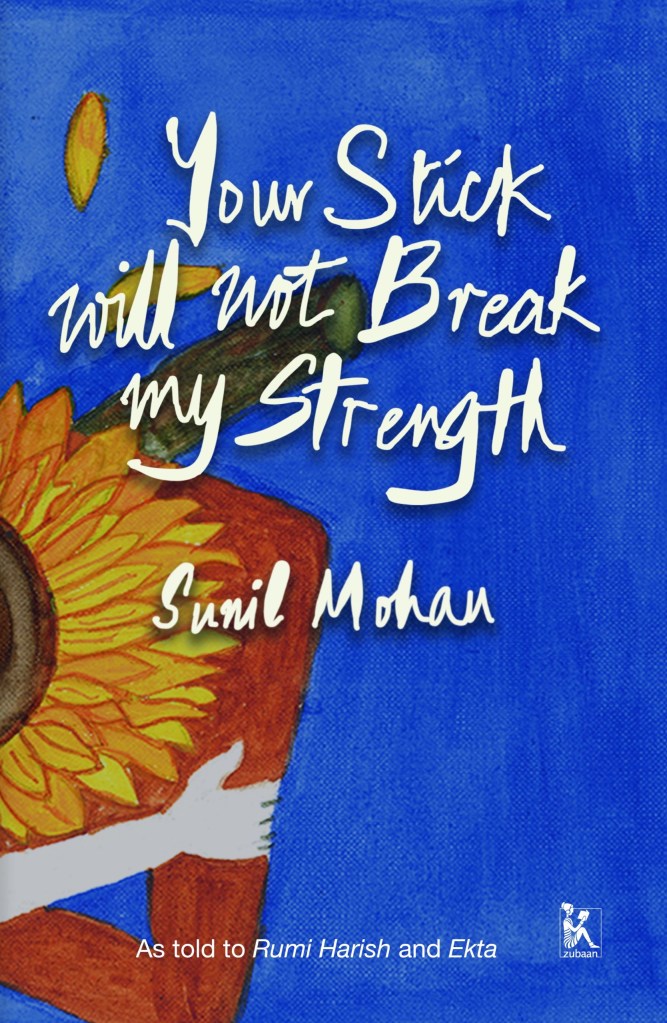
If Bernardine Evaristo’s Girl, Woman, Other functions as a bible on feminism and its intersectionality, then Sunil Mohan’s memoir is a meditation on masculinity, trans masculinity and their many intersections. Through his lived experiences, Sunil has dissected the concepts of masculinity and patriarchy and how in our societies, they become interchangeable, feeding into one another in deeply corrosive ways, and yet how societies and communities are built on a machinery that perpetuates their growth and favours the intermingling between them.
As a trans man, Sunil has brought to the fore the lived realities of being a trans individual in India whilst examining the same through the lens of societal prejudice and internalised conditioning. He has lamented on the absence of trans masculine narratives in public discourse and how even within the queer community and queer spaces, they remain invisible. Trans men continue to exist on the fringes of society despite their embrace of masculinity. Sunil also astutely questions if trans masculinity and cis masculinity have any commonality and whether masculinity itself can become intoxicating and addictive if one fails to interrogate the privileges it inadvertently bestows.
Sunil shares his experiences of working in various NGOs throughout his career and how this has shaped his understanding of how these spaces operate. He candidly recounts instances where his unwavering demand for rights was labelled rebellious, within organisations meant to support him and his community. These experiences only strengthened his resolve to disrupt the hierarchies that plague NGOs working for the marginalised and often do more disservice than good due to the said hierarchy. He simultaneously questions the cis heteronormative authority that governs trans upliftment spaces. Raahi, an organisation co-founded by Sunil, dedicated to the rights of marginalised genders and sexualities, was born out of such an angst and a necessity for people rehabilitating their own communities, one that is rooted in collective care rather than any of the institutionalised hierarchies.
Sunil Mohan has also confronted the oppressive nature of the Brahmanical system head on. He doesn’t shy away from enumerating the various ways in which this system has been synonymous with power and patriarchy. People get marginalised and deprived of their rights because of the casteist and capitalist ideas inherently embedded within this brahmanical system. Sunil’s emphatic voice through the book will be a reality check for all of us who belong to this system and continue to benefit from these structures without acknowledging the centuries of violence they have produced and continue to produce. Importantly, he urges readers to reflect on how one might detach from domination and meaningfully contribute to democratic, egalitarian futures.
Although Your Stick Will Not Break My Strength is a memoir, it defies the conventions of the genre. Sunil mentions his early days when he was a part of the Kerala Women’s cricket team, a time when the sport and its uniform offered temporary refuge from the alienation of his female-assigned body and the oppressive dominance of his father. He narrates his struggles with remarkable restraint, refusing to romanticise pain. He has used his decision to transition as a means to provide us with an invaluable insight into the mind of anyone who is thinking of transitioning. He also wonders about society’s fixation on penile bodies while keeping his transition in mind, and within the trans masculine community while also attempting to make everyone comprehend the infinite social and cultural supremacy and superiority that these penile bodies come to possess.
Notably, Sunil chooses not to centre himself or his numerous achievements in his own memoir. Instead, he has used it as a platform to dismantle the potent patriarchal beliefs that promote casteism, queerphobia, transphobia and marginalisation. In fact, his nuanced exploration of hierarchies within the marginalised and the marginalisation within the marginalised is sensitive, intuitive and deeply intelligent.
Your Stick Will Not Break My Strength is both an unflinching account of the perils plaguing the trans and trans masculine communities and a courageous introspection into their internal contradictions shaped by the dominion of patriarchy and the Brahmanical order. This book is a masterclass on humility, compassion, empathy, resilience and responsibility. Sunil has shown us how memoirs are to be written, how one can deconstruct the sociocultural mores and jingoistic politics through the power of one’s story. Finally, as a trans man, Sunil has written an autobiography (as narrated to Rumi Harish and Ekta) without making it a ‘trauma porn’ designed for the cis het gaze. He refuses victimhood and instead charts a path toward collective healing through friendship, community, silence, commitment, patience and perseverance.
A must-read. Truly!
( Some quotes from the book:
“When we construct “our” spaces, why do we again recreate the same patriarchy and masculinity? Did we struggle to get out of the toxic masculine patriarchy that controls and puts boundaries on non-cis female bodies, only to recreate and reconstruct the same?”
“I often felt disturbed and uncomfortable about another issue: single-leader-driven movements.”
“When we were discussing masculinity, we realised that another masculine trait is to have the power to “correct” others through force and violence, to control and regulate everyone. This kind of power also pulls sexual violence into its ambit and is premised on “showing someone their place”.”
“Sometimes, I have felt that feudalism, monarchy, fundamentalism, fascism, religious superiority, sexual actions and reproduction, marriage, morality, the supposed superiority of the self, caste, race, blood, lineage, and food are all different expressions of “masculinity”.” )
~ JUST A GAY BOY. 👏👏
 the shiny diaries