Brotherless Night

šŸ“ Jaffna, Sri Lanka šŸ‡±šŸ‡° 

Sashi is an earnest, young girl full of hope and aspirations, dreaming of becoming a doctor and serving her people in Jaffna. Her family consists of her parents and four brothers. The eldest, Niranjan is already a doctor and dotes on her, constantly encouraging her to study so that she can crack her exams. Seelan and Dayalan, have natural political inclinations and often engage in charged rhetoric. Aran is subdued and wanting a simple and peaceful life. However, it’s 1981 and life in Jaffna is never peaceful. The Tamils are facing crackdown and oppression from the government resulting in a growing dissent and uprising. Niranjan disappears during one such riots in Colombo; their grandmother’s house gets torched to ashes by violent zealots while Sashi and Ammammah escape and endure a perilous and arduous journey back to Jaffna. These events prompt Seelan and Dayalan to join the militant group, Tamil Tigers, who now have taken control of whole of Jaffna. As the government and Tamil Tigers engage in skirmishes, Sashi gets admission to a medical school. There, persuaded by her friend K, joins the Tigers’ field hospital and starts treating their cadres as well as civilians. At her college she comes across her professor who soon becomes her mentor and confidante, Anjali. However, with the political situation becoming increasingly volatile and dangerous, she loses Seelan and Dayalan to the movement; Anjali gets abducted and Aran decides to emigrate. Sashi is gripped by her righteous rage and beliefs, and faces the predicament of whether she should stay back or join Aran and how her future now depends on this very important decision. 

The book is a breathless, often claustrophobic account of Sashi’s difficult choices, her internal struggles as she oscillates between interests and intentions, her emotional turmoils as she navigates loss and grief, and her mental prowess dealing with hope and hopelessness. Sashi as a character is an unassuming force to reckon with. The narrative also takes us on a journey of Sri Lanka’s political quagmire, the helplessness of Tamil civilians as they are caught between the militant groups, the government and the Indian Peace Keeping Force. Massacre ensues as places and people get bombed, and depression looms large at every turn. 

Brotherless Night, winner of the Women’s Prize for Fiction 2024, is a historical fiction written so brilliantly, that it is unsettling and uncomfortable. The gifted author, V. V. Ganeshananthan, builds the restlessness of the characters, as they encounter death and dilemmas and keeps the book unrelentingly atmospheric. The writing is compelling and persuasive, peppered with Tamil words. Tamil culture, cuisine and traditions get the requisite mention throughout the book. There are moments of such literary brilliance in the book; the scene where Sashi’s docile mother emerges as the proverbial phoenix and leads an uprising against the government along with a group of fierce, inspiring women; the dialogues between Anjali and Sashi as they contemplate the movement, the militants and their pursuit and purpose; as also the extremely unnerving and shocking medical examination scene of a rape victim, brutalised by the Indian Peace Keeping Force. 

Brotherless Night will disturb you and it should. It is a complex catastrophic story of survival amidst doom and despair. The ingenuity of the author is such that despite the barbarism and violence on display, humanity finds its place; in the thoughts, conversations and actions of its various characters. This is literature at its finest; V. V. Ganeshananthan, its proud torchbearer. 

~ JUST A GAY BOY. 🄹

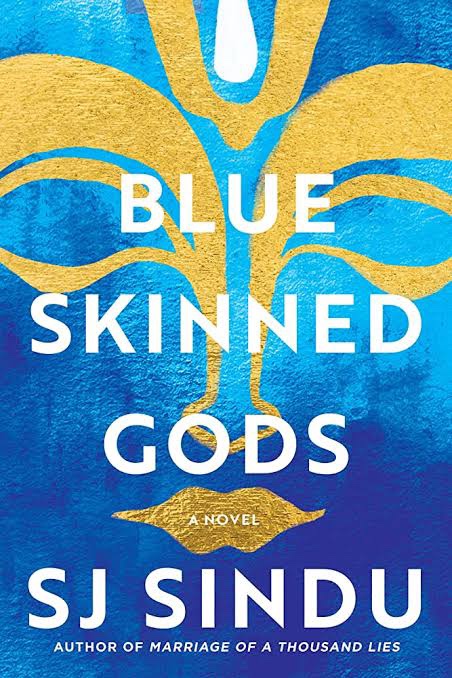
Blue Skinned Gods

A story that weaves a rich tapestry of emotions embedded in superstitions and beliefs need not be the most unusual or awe inducing. However, Blue Skinned Gods, finalist in bisexual fiction in the 2022 Lambda Literary Awards, is a story that gives layers to the same emotions, provides nuances in the narrative and simultaneously transports you to a world that’s at times unbelievably despondent and many a times believably blindsided.

The story set in Tamil Nadu, is about a blue skinned boy, Kalki, who is made to believe and thought to be as the last avatar of Vishnu; because of his skin colour. His father, Ayya, forces this belief not just onto Kalki and his entire family but the whole village, so much so that be builds an ashram for him, which also serves as a healing space for people troubled by physical and mental ailments. To perpetuate his notion, Ayya doesn’t shy away from deceit, abuse, punishments and emotional torture. Kalki soon starts believing in his own godliness and prowess, despite nagging doubts regarding the same. He becomes codependent on Ayya and no amount of abuse, including his mother’s loss, seems to make him stand up against his father. However, when he lands in New York city as part of his world tour, reality hits hard and Kalki begins his journey of emancipation and self discovery albeit through alcohol, sex and being emotionally distraught.

S J Sindu (she/they), Tamil and genderqueer, has masterfully authored this complex narrative of regret, remorse and redemption, through the lens of a docile, bereft and fragile character like Kalki. There are times when as a reader you want Kalki to rebel and retaliate, however his ingrained trauma and abuse prevents him from doing so. And this is the truth for many such childhood trauma survivors. Sindu presents trauma as this multilayered annihilator that destroys a person’s sense of being despite the right reckoning.

Blue Skinned Gods is rooted in Tamizh culture. The narrative is peppered with beautiful, lyrical Tamizh words. Hindu religious beliefs and mythology form the backbone of the story. Sindu has presented this alongside science and rationalism without putting them at loggerheads. The nuanced references to casteism and sexism in Hindiusm has been done ever so poignantly without being provocative. The various queer characters in the book bring their own uniqueness to this moving tale centred on humanity.

Do read!

~ JUST A GAY BOY. šŸ˜‡

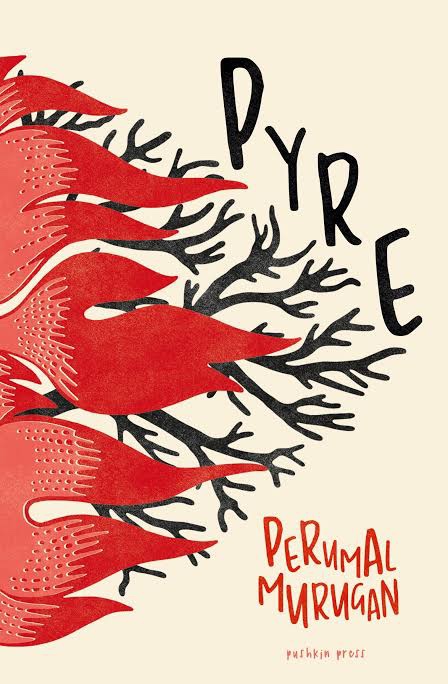
Pyre

Perumal Murugan is an author, scholar and literary chronicler who writes in Tamizh. He has written ten novels; five of them have been translated into English. As a professor of Tamizh literature, he has made several contributions to research and academic study of Tamizh literature specific to Konganadu region. He courted controversy with his book Madhorubhagan which made him announce, ā€˜Perumal Murugan the writer is dead’. His novel Pookuzzhi (Pyre) was originally published in Tamizh in 2013 and translated into English by Aniruddhan Vasudevan in 2016. It has now been longlisted for The International Booker Prize 2023.

Pyre is a heart wrenching story of an intercaste couple, Saroja and Kumaresan. Saroja elopes and marries Kumaresan, who then brings her to his remote, arid and decrepit village of Kattuppatti, in the hinterland of Tamil Nadu. Upon arrival, the couple are welcomed with abuses, mourning and threats. Saroja becomes their easy target, and is showered with expletives and profanities, especially from the womenfolk, and Marayi, her mother-in-law. Each passing day becomes a living hell as the villagers become hell bent on knowing Saroja’s caste. As the story progresses, there seems to be no sympathy or changed behaviour by the villagers towards the couple, who believe that this marriage is an impending doom, and start plotting a heinous crime against them. The couple though, remain in love, crave love yet have no idea that the same love is a harbinger of hatred and enmity.

Pyre is a grim telling of the realities of caste differences and discriminations present in our society. Through this lens, Murugan tells a riveting tale of the people who put caste on a pedestal. He centres caste as the unrelenting, unforgiving protagonist in the book. You may despise its presence, still remain helpless, just like Saroja and Kumaresan. The internalised misogyny that Marayi spews onto Saroja, is a depiction of the ways in which caste and such other forms of bigotry manoeuvre, such that those who are oppressed become the oppressors.

The harsh landscapes and terrains of Kongunadu form an integral part of this story. The barrenness of the land which the author describes evocatively becomes deafening through the narrative. The villagers’ reverence to caste whilst ignoring its beguiling notoriety to cause persecution remains a passive subtext all through. Perumal has fleshed out his characters; be it a listless yet restive Saroja, a pensive yet petulant Kumaresan or a scornful and savage Marayi. Aniruddhan Vasudevan’s translation of Perumal’s crude and caustic prose is unparalleled. He has managed to imbibe the nuances of the original language during the tender moments in the book as well as during the diatribe. Being a Tamizh speaker myself, I appreciate and applaud the sensitivity and restraint in Aniruddhan’s translation.

Pyre is a disturbing read. Perumal Murugan writes to unnerve you, to push you out of your bubble, to give your prejudices and preordained thoughts a 360 degree spin. He makes us, the reader, a mute spectator to the atrocities as they unfold. But isn’t that true in real life too? Aren’t we/ haven’t we become mute spectators to all kinds of caste, gender, religion, social status based atrocities? Aren’t we/ haven’t we become complicit in this despotism?

~ JUST A GAY BOY. šŸ˜“

A Passage North

Sri Lankan author, Anuk Arudpragasam’s second book, and also shortlisted for Booker Prize 2021, is striking but deliberately difficult. The book is a meandering tale of a Sri Lankan Tamil man, Krishan, living in Colombo, who is now faced with the news of his grandmother Appamma’s caretaker, Rani’s death in the far flung village of Kilinochchi, in the Northern Province of Sri Lanka. As Krishan leaves on this train journey to the North, a region devastated by the civil war, he starts ruminating on his life’s choices and outcomes; philosophically analysing them, in the context of the inevitable truths of grief, loss, trauma and death.

As the author builds Krishan’s narrative, he also introduces us to the relationships he shares with all the women in his life including mother, grandmother, Rani and his former girlfriend Anjum. Anjum is an Indian girl, he meets while in Delhi. Though they share a ā€œfriend with benefitsā€ relationship, more so from Anjum’s perspective; Krishan feels drawn to her romantically. Since separated and not in touch, Krishan keeps reminiscing about her; he remains in denial about the unrequited love and his inability to come to a closure.

Through the story of Rani, the Tamil woman, who loses both her sons to the war and is now battling severe clinical depression, the author brings to fore the turbulent times of the country when the Tigers and the military were engaged in a destructive duel. The book also has detailed multi-page recountings of Tamil poems, Buddha, and television documentaries.

Through the book, very little happens. While the author is adept at illustrating our most private and everyday emotions and thoughts lucidly; at the same time, it also feels like rambling. The dialogue-less prose, is full of long, laborious and word-y sentences. The character of Krishan comes across as inconsequential, indecisive and tedious.

To summarise, the book feels more like an indulgent experience, than immersive.

~ JUST A GAY BOY. 😶