Vera Wong’s Unsolicited Advice for Murderers

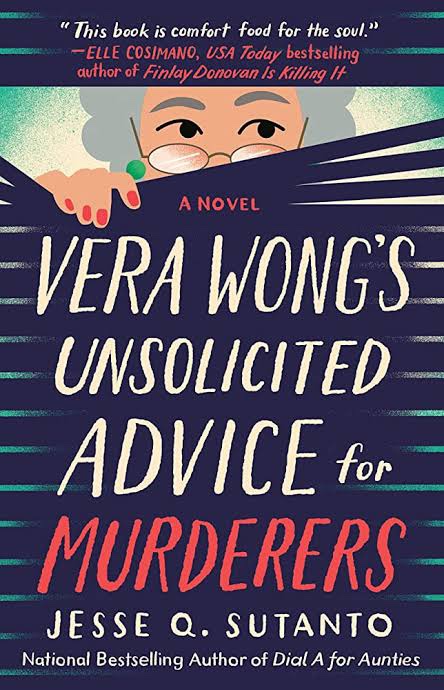
Vera Wong is a punctilious, loquacious sexagenarian who runs Vera Wang’s World Famous Teahouse in the Chinatown area of San Francisco. But here’s the thing, the tea house isn’t famous (even in Chinatown!) and she has no one to talk to (her only son Tilbert ignores her for the most bit). It all changes the day she discovers the dead body of a certain Marshall Chen in her tea house. This attracts a slew of new visitors to her establishment, who also turn out be murder suspects. When Vera fails to get a satisfactory response from the local police, she takes it upon herself to solve the murder mystery.

Amateur sleuth Vera’s list of suspects include Julia, the wife; Oliver, the brother and Marshal’s two other acquaintances Riki and Sana. As she goes about her way in knowing these people and unearthing their motives and intentions; she also starts forming unlikely and unforeseen bonds with them. The camaraderie between all of them develops so organically that Vera feels hesitant to know who the murderer is. Nonetheless her forthrightness makes her go all the way till she actually nabs the culprit.

As much as the book is a taut, crisp whodunnit; it’s also a heartwarming story about human relationships and friendships. The author has written every character with utmost consideration and has spent time in developing each of their mental and emotional arcs. But the stand out has to be Vera Wong. She is fiesty and funny with a pertinent dislike for mendacity. Though she mostly despises youngsters and their nonchalant way of life; she remains the most inquisitive person when it comes to new technology, terminology and even tiktok. The highlight of the book has to be the uplifting narrative, the unassuming feminism and Vera’s pragmatic attack on misogyny and chauvinism. Jesse Sutanto’s emphasis on the need for building social connections and a safe community is so relevant in these current times of a loneliness epidemic.

The book brews over with an abundance of aromatic teas and concoctions. Vera serves us steaming cups of delicious teas for every occasion and emotion. She has a solution for everything in a tea. Well not just that, she cooks up a storm and the pages are laden with scrumptious and luscious Chinese dishes. The author meticulously describes the cuisine such that, you can smell the piquant aromas whilst reading the book.

This murder mystery is one delectable fare. Dig in, as I sip on my tea whilst not spilling any!

~ JUST A GAY BOY. 🧐

This Arab is Queer

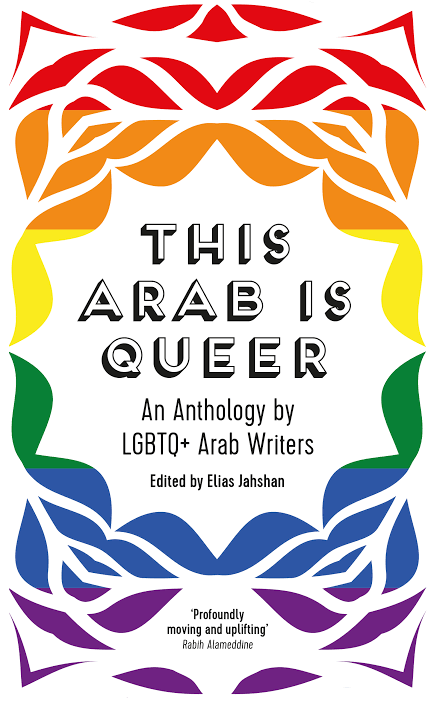
I feel, I am blessed to have read this book, that too during pride month. The book, which the Time magazine hailed as ‘groundbreaking’, is indeed that. It’s also trailblazing in so many ways. It’s an anthology of 18 essays written by queer Arab writers from the SWANA region, edited by Elias Jahshan, a Palestinian Lebanese journalist living in Australia. Now when was the last time you heard or saw space for a queer arab? And that’s the power this book yields. By asking 18 brilliant writers to write their stories, their way, many through their lived experiences, this book embodies the queer arab narrative, emboldens the queer arab and makes their visibility and intersectionality a necessity. While the stories are rooted in the arab-ness and queerness, diaspora or otherwise, the feelings of dignity, safety, and belongingness remain universal.

The book begins with the feminist giant (that’s also her newsletter) Mona Eltahawy’s essay, The decade of saying all that I could not say. Mona, a survivor of sexual assault, has been a crusader against patriarchy. In her essay she astutely describes her reckoning of owning her sexuality, her bisexuality, and the umpteen nuances that make it so. Her liberation by shedding the shame surrounding sex, has been an act of rebellion. As a Muslim woman, her vehement uprising against heteronormativity has been her emancipation. Mona writes not just to inspire us but to instigate our power.

Though each essay is profound, I would like to highlight a few that stayed with me. Amrou Al-kadhi’s essay, You made me your Monster, is a fierce, defiant take on Arab-ness, Quran and his Islamic identity. His transgressions viewed as blasphemous in the Arab world are just his ways of honouring his own authentic existence. Through his flamboyant, glamorous drag persona, Glamrou; Amrou is reinforcing the power in provocation.

Danny Ramadan, in his essay, The Artist’s portrait of a marginalised man, talks about how his writing is always up for debate, whether it’s fiction or non fiction and if it’s based on his real life experiences, simply because he’s a queer Syrian man with a refugee experience. He poignantly points out people’s assumptions about him and his work since he’s a queer arab and also worries if his real life trauma is going to unknowingly and inadvertently slip into his every narrative.

Amna Ali’s essay, My intersectionality was my biggest bully, is an eye opening piece about her journey as a Black Queer Arab. Growing up as and being a visibly Black person in a racism predominant society like UAE, Amna had a tumultuous upbringing wherein she was taught to be shameful about her blackness. Later, she became shameful about her queerness too. This amalgamation of multiple identities made her distraught, caused her abuse and violence, until she learnt to make peace with them. Amna has since realised her intersectionality as a Somali-Yemeni-Emirati queer person, is her true strength and yet it continues to be an arduous journey.

Hasan Namir’s story, Dancing like Sherihan, is about his tryst with shame due to his queerness leading to his ingrained belief about him being a sinner. His strict Iraqi Muslim upbringing was always at odds despite him moving to Canada and experiencing queer freedom. His essay deftly portrays the internal struggles of a queer person as they oscillate between religious virtues, familial pressures, internalised shame and queer trauma. Hasan’s relationship with Tarn, leading to their marriage and later having a child is one that of queer joy. It makes you misty-eyed, it makes you hopeful and it feels like a collective queer victory.

Madian Al Jazerah’s moving piece, Then came Hope, is an ode to him as a displaced Palestinian Queer man who is constantly engaged in an embittered battle with shame whilst remaining hopeful that he would emerge triumphant. His trauma is multilayered as he navigates zionism and homophobia. His astute observations on the blatant yet veiled discrimination in the gay world is one that many of us can identify with. Madian has a beautiful bookstore in Amman which I had visited back in 2019. It’s now through this book that I know the connection between the bookstore and him and have been so ecstatic since. Queer joy indeed comes in so many forms and experiences. I would like to quote a couple of lines from his essay which I felt were earth shatteringly brilliant. Here goes;

I know from experience that you can put shame on the highest shelf and forget about it for a while, but bigots and bullies can smell it and it is always within their reach.

When we talk about love, the image of a heterosexual couple is accompanied by a thousand positive romantic associations. When we talk about gay men, the image is of two men having sex.’

Many or most of these stories are about shame and trauma, and that’s so true since those are the first feelings one experiences as a queer person. They also highlight the yearning for love, acceptance and inclusion. These stories are a lot tragic, which just goes on to show the commonality in their lived experiences as a queer arab. At the same time, the writers have done a commendable job in instilling faith and hope despite their grim realities of being a queer arab in a world so hostile towards them. This is a book that is going to jolt you out of your assumptions, privileges and entitlements. Burst that bubble, it’s time for a masterclass on humility and humanity.

Elias Jahshan has done beyond stellar work as an editor. Bringing together each of these supremely talented and gifted writers is not just groundbreaking but distinctively exceptional. Take a bow!

~ JUST A QUEER HUMAN. 🥹🥲

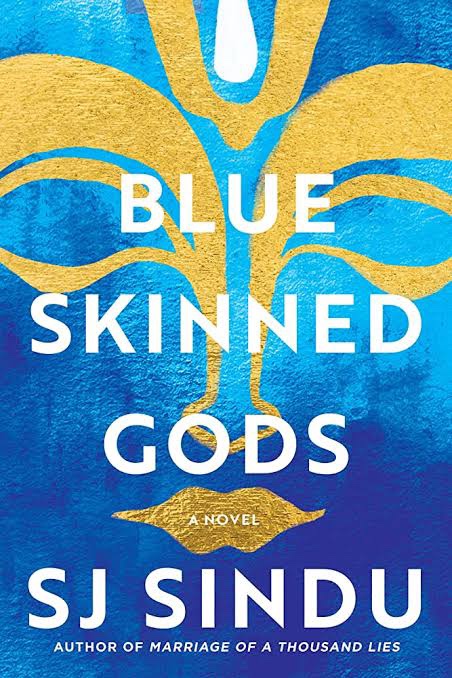
Blue Skinned Gods

A story that weaves a rich tapestry of emotions embedded in superstitions and beliefs need not be the most unusual or awe inducing. However, Blue Skinned Gods, finalist in bisexual fiction in the 2022 Lambda Literary Awards, is a story that gives layers to the same emotions, provides nuances in the narrative and simultaneously transports you to a world that’s at times unbelievably despondent and many a times believably blindsided.

The story set in Tamil Nadu, is about a blue skinned boy, Kalki, who is made to believe and thought to be as the last avatar of Vishnu; because of his skin colour. His father, Ayya, forces this belief not just onto Kalki and his entire family but the whole village, so much so that be builds an ashram for him, which also serves as a healing space for people troubled by physical and mental ailments. To perpetuate his notion, Ayya doesn’t shy away from deceit, abuse, punishments and emotional torture. Kalki soon starts believing in his own godliness and prowess, despite nagging doubts regarding the same. He becomes codependent on Ayya and no amount of abuse, including his mother’s loss, seems to make him stand up against his father. However, when he lands in New York city as part of his world tour, reality hits hard and Kalki begins his journey of emancipation and self discovery albeit through alcohol, sex and being emotionally distraught.

S J Sindu (she/they), Tamil and genderqueer, has masterfully authored this complex narrative of regret, remorse and redemption, through the lens of a docile, bereft and fragile character like Kalki. There are times when as a reader you want Kalki to rebel and retaliate, however his ingrained trauma and abuse prevents him from doing so. And this is the truth for many such childhood trauma survivors. Sindu presents trauma as this multilayered annihilator that destroys a person’s sense of being despite the right reckoning.

Blue Skinned Gods is rooted in Tamizh culture. The narrative is peppered with beautiful, lyrical Tamizh words. Hindu religious beliefs and mythology form the backbone of the story. Sindu has presented this alongside science and rationalism without putting them at loggerheads. The nuanced references to casteism and sexism in Hindiusm has been done ever so poignantly without being provocative. The various queer characters in the book bring their own uniqueness to this moving tale centred on humanity.

Do read!

~ JUST A GAY BOY. 😇

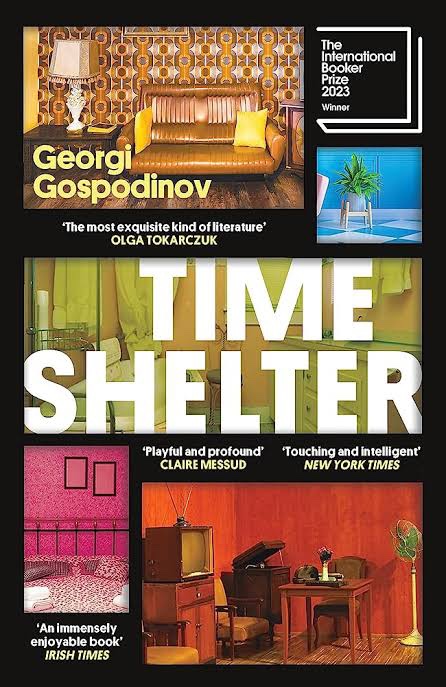
Time Shelter

(spoilers ahead; mostly it’s my interpretation)

There’s a reason why certain books win the coveted International Booker Prize. Simply put, there isn’t a book like that; a writing like that, a story like that; that you would have read or ever come across. Time Shelter, winner of the 2023 International Booker Prize, is certainly one such book of course, but more than a book, it’s a collection of nostalgia, of memories; and of the times when these memories start fading.

The story is about a psychiatrist, Gaustine and an unnamed narrator. Gaustine opens a clinic for patients suffering from Alzheimer’s disease in Zürich. Each decade has been recreated in this clinic from the decor to the newspapers of that time. Patients come into the clinic, and through this memory evoking therapeutic sensory experience, start remembering, recognising and reliving the forgotten time. The narrator becomes fascinated, almost borderline obsessed with Gaustine’s ingenious idea and becomes a part of his team in building such clinics all across Europe. Before you know it, the entire world is now building these clinics, even planning cities dedicated to certain eras and decades. Countries have referendums on which past year or decade be chosen to be recreated. As with any fantastic idea, this ambitious project too, marred by its pomposity, soon starts to disintegrate into chaos and mayhem.

There was this surreal moment whilst reading the book, when the penny dropped for me. I realised the beauty of this book and the craftsmanship of the author, Georgi Gospodinov (masterly translated from the Bulgarian to English by Angela Rodel) in writing a tale like this. The author has exposed us to the mind of the narrator who is writing this book and who is losing his mind. Now what starts as a story soon morphs into his recollections and learnings of history and later into a series of uncoordinated events. We become witness to his dementia. We are put onto the edge of the precipice of an individual losing himself and his autonomy. This realisation jolted me, suddenly the book developed an eerie undercurrent because what I had thought to be benign till now, wasn’t really so. So I wondered, did Gaustine ever exist? Or was the narrator Gaustine?

The book is rich in Bulgarian and European history. The author juxtaposes this richness with the hypocrisy prevalent in European politics. His satirical narrative takes us on a raucous journey from World War II to Brexit. The author deliberately changes the writing style and language through the course of the book. What starts off as poetic, lyrical and contemplative in the beginning, later becomes tedious and monotonous, only to end disjointed. Through Time Shelter, Gospodinov, has attempted to highlight people’s obsession with the past, only so much as to stall the future whilst forever remaining oblivious to the present. Not an easy book to read for sure, but if you do read (which you must!), you can marvel at Georgi’s innate literary genius. Now let’s ruminate on the title. Goosebumps!

~ JUST A GAY BOY. 🥸

Crafting the Word: Writings from Manipur

📍 Manipur

The book is an anthology of short stories, essays and poems, many of which are translations from the Manipuri into English, all written and translated by women writers from Manipur; edited and put together by Imphal based independent journalist, writer and translator, Thingnam Anjulika Samom. Many prominent Manipuri writers feature in the book from the yesteryears to the current. Particularly noteworthy amongst them was Binodini, who was a Manipuri novelist, essayist, playwright, screenwriter and lyricist. Her collection of short stories in 1965 was the first by a Manipuri woman. Her story, Girls’ Hostel Sri Bhavana; translated by L. Somi Roy, evokes a sense of nostalgia and grips us with the tenderness of love and belonging.

The book begins with an elaborate and nuanced essay, The Journey of Women’s Writing in Manipuri Literature, by Nahakpam Aruna, on the various Manipuri women writers and their contributions to the craft and society at large. The writings in the book form a social discourse on the position of women and women’s rights in Manipur. Patriarchy, misogyny, abuse, gender and caste based discrimination, menstruation form recurring topics in the various stories and poems. Though every story is profound, three of them caught my attention. These are: 1) Sati interview by Ningobam Sanatombi, translated by Kundo Yumnam, which takes a very poignant and satirical look on women’s rights in Hindu mythology; 2) Nightmare by Nee Devi, translated by Soibam Haripriya, is a tragic lesbian love story wherein the lesbian lovers, Somo and Leishna, are at the receiving end of their respective homophobic and abusive families; 3) The Defeat by Ningombam Surma, translated by Bobo Khuraijam, which, through the story of a married couple, Bipin and Nalini, brings forth the hidden chauvinism present in the often revered so-called feminist men.

The writings are simple and the language lucid, but they pack a punch. The messages that they convey can keep echoing long after you have finished the book. Manipur is currently in a state of utmost unrest, turmoil and despair. I hold this book close to my heart whilst thinking about all the people there, especially the women and these brilliant women writers. May peace and stability reign.

~ JUST A GAY BOY. 🫥

Black Foam

📍 Eritrea 🇪🇷

This is a book like no other. The novel, written by Doha based Eritrean novelist Haji Jabir, was originally published in Arabic in 2018 and, is the first Eritrean novel to be longlisted for the 2019 International Prize for Arabic Fiction. It has been translated into English by Sawad Hussain and Marcia Lynx Qualey. The story is about an Eritrean soldier’s relentless pursuit in finding stability, hope and freedom as he traverses from Eritrea to Ethiopia to Israel. Adal fights as a soldier in The Eritrean war of Independence against Ethiopia and sees his country achieve it. While Asmara celebrates the new freedom, Adal changes his name to Dawoud, because he doesn’t want to be associated with it. During his time at the Revolution school there, his infractions lead him being sent to the torture prison at the Blue Valley. He escapes the prison to land in Endabaguna refugee camp in North Ethiopia where he becomes David. From there, he manages to enter the Gondar camp in the Amhara region of Ethiopia, posing as a Falasha Mura (Ethiopian Jew) named Dawit. This helps him in getting to Israel, finally to Jerusalem. This arduous journey which converts him from a soldier to a refugee, whilst he assumes various identities and religions, shakes him to his core; challenges all his beliefs and notions about the world and humanity. Ultimately, he finds a glimmer of solace when he visits the Al-Aqsa mosque in the West Bank region of Jerusalem, Palestine; it appears to him, as if life has come a full circle and there he starts questioning his identity and whether he may now be a part of a community of African Palestinians.

Black Foam is a composite story that, at the outset, through the protagonist’s character highlights the struggles and atrocities faced by a refugee. However, as we delve deep into the narrative, it holds your attention towards a plethora of unspoken issues and peoples. A nation’s independence needn’t necessarily attribute independence to all its citizens. As a soldier, Adal was left stifled living that life, though now Eritrea was free. However, his mindset was such that, he could never accept freedom, which led him from one refugee camp to another. The book also talks about the plight of Ethiopian Jews, who remain at the mercy of the Israeli Jews and live like second class citizens in the country. The story also talks about Palestine and lives of Palestinians living under the apartheid regime of Israel. Whilst weaving a sombre and at times discordant narrative through these complex geographies, the author simultaneously constructs the romantic and sexual life of the protagonist. This juxtaposition in the storytelling is distracting, deliberately pervasive and at times tedious.

Haji Jabir has masterfully sketched this story of a man in search of a home, security, a sense of belonging only to be met by hostility and uncertainty every step of the way. This quest is sadly the tale of millions of refugees in various parts of the world. Kudos to the author for writing it, keeping the despair and depravity alive in every page; for breathing life into the forgotten lives of the refugees; for portraying doom as a running subtext to the entire narrative. The descriptions of Jerusalem, West Bank, Al-Aqsa Mosque, Church of the Holy Sepulchre, is so detailed, nuanced; it’s almost as if we are there with Dawoud/ David/ Dawit as he roams these streets searching and questioning his life’s meaning and purpose.

Black Foam is a bittersweet melancholy that will stay with you long after you have finished reading it.

~ JUST A GAY BOY. 🥺

A stone is most precious where it belongs

This book is a compelling narrative on Uyghurs; their life, culture, geography and the strife unleashed upon them by the Chinese government or the CCP (Chinese Communist Party). The Uyghurs are a Turkic ethnic group from the autonomous region of Northwest China known as East Turkestan, which has been renamed as Xinjiang by the CCP. Modern Uyghurs are primarily Muslims and they are the second largest predominantly Muslim ethnicity in China after the Hui. The modern Uyghur language is classified under the Turkic language family and has an Arabic script. Gulchehra Hoja, author of this book, has written a memoir and through that, has encapsulated the trials and tribulations of her people and the ongoing modern day genocide.

Hoja, born and raised in Ürümchi, the capital of the then erstwhile East Turkestan, comes from a lineage of musicians and artists. Her family was known for their contributions towards the Uyghurs’ cultural landscape, and she had a very liberal upbringing. Gulchehra, upon completing her studies was chosen to be the face of Xinjiang Television’s children’s show. Whilst the show initially started off as a celebration of Uyghur culture and traditions, it gradually morphed into a CCP propaganda piece. Soon she realised how little to no control she had in the proceedings of the show and that, that she was becoming a puppet at the hands of the Han authorities running the channel. Now, the Chinese government had always wanted complete control of the Uyghur region and had started asserting their supremacy by sending Han Chinese civilians to live and work there. Chinese language was forcibly introduced in schools and other governmental establishments. Uyghur civilians were finding it more and more difficult to be themselves or practice their faith. The more Gulchehra understood the threats to her freedom and her Uyghur people, the more uncomfortable she got. One fine day, when she got an opportunity to go to Europe, she learnt starker truths and gory details of the Chinese government in the programmed oppression of the Uyghur, thanks to the free internet available in Europe. This prompted her to make a life changing decision to go America and work for Radio Free Asia (RFA), which simultaneously meant that, she could never come back to her land and her family.

As a journalist at RFA, Hoja gave the Uyghurs a voice that could be heard all across the globe. She brought to light the brutality and racial killing perpetuated by the CCP while promoting their ethnocentric agenda. This bold and fearless reporting only meant trouble for her family back home. She was soon branded as a separatist/ terrorist and her immediate and extended family were imprisoned and treated in the most inhuman way possible. Gulchehra battled immeasurable feelings of guilt and sorrow, but she continued her reporting nonetheless. Her personal life was a complete mess too, with an estranged husband and a budding love interest. However, Gulchehra remained committed to her Uyghur people, never lost focus of her responsibility towards them and through this extremely difficult journey, she portrayed her resilience, compassion and bravado.

What is happening to Uyghurs, is a genocide. The Islamophobia that is rampantly being broadcasted by the CCP is dangerous. There’s genocide happening of the Palestinians by apartheid Israel as well. The world, somehow has turned a blind eye to these genocides and various such Islamophobic propagandas. As I read this book, a chill ran down my spine. The measures taken by the CCP for this ethnic cleansing include detention camps (euphemised as vocational skills education training centers), forced sterilisation, disappearance of dissenting civilians, torture, violation of privacy, hi-tech mass surveillance, religious persecution, unreasonable incarcerations, suppression of free press. Now, only an imbecile or a fanatic should be able to not draw parallels to the situation here at home. Maybe there aren’t any detention camps or forced sterilisations yet, but Islamophobic rhetoric has become mainstream. And if you broaden the scope and look beyond the lens of any kind of phobia, you shall note that this is signalling of a rise in autocracy and complete totalitarianism. Let’s not shun an Uyghur or a Palestine as a localised geopolitical issue. The fanaticism used in this oppression has worldwide ramifications and replications. After the Holocaust, the world vowed that it would never ever allow another humanitarian catastrophe. Yet in 2023, we are not only seeing such events and genocides happening but also becoming widespread. How many more of such massacres would it take for the world, for us to get out of our ignorant slumber?

~ JUST A GAY BOY. 🥺

Lessons in chemistry

When was the last time you were taught lessons in feminism that was easy breezy, devoid of angst and presented with hilarity? I don’t think ever. It’s rather unfortunate that feminism has to be schooled. Also, this isn’t any kind of shade on all those glorious women who have taught feminism with an angry diatribe. Because clearly the world hasn’t been kind to women since time immemorial. And we get a sneak peak into this unjust scheme of things through the book’s main protagonist Elizabeth Zott. The story is about this fierce woman scientist who is never taken seriously because of her gender. Set in the 1950s America, the book takes a hard look at the subordinate and often demeaning outlook of the society towards women then. Elizabeth is passionate about chemistry and struggles to make herself seen in the overwhelming and dismissive world of men. Adversities and inappropriate men force her to switch her career quite reluctantly. From a scientist she soon becomes a television cooking show host. Despite her rather unconventional approach to anchoring, she becomes very popular and women all across America can’t seem to get enough of her show. Because hers is a first show of its kind wherein women are tutored to think they matter; they are important and they are equal. All this whilst cooking up a storm and diligently doling out chemical equations and reactions.

To say this book is unbridled joy would be an understatement. Elizabeth Zott defies all the societal conventions and expectations and still remains an embodiment of womanhood. Her bold choices which if you examine carefully, were just about what mattered to her and what was convenient; can actually trigger the chauvinists and misogynists. Her decision to have a child without being married, to have a live-in partner, to be an atheist, to question authority are just some amongst many reasons which make Elizabeth Zott unique and her own person. She epitomises freedom, equality, independence, intelligence and her actions can inspire women all across the globe to stand up for themselves, to speak up for other women, and to support one other in solidarity.

Bonnie Garmus, the ingenious author and who’s debut book this is, gives us a taut and crisp story that never falters, never slackens its pace and delves deep into feminism while serving a healthy dose of uncanny, straight-faced humour. The author deftly handles complicated and emotional topics of sexual abuse, rape, patriarchy, and childhood trauma. Garmus gives us this iconic character of Elizabeth Zott, who strives for rationality every step of the way. Not just Elizabeth, the book is peppered with various other notable characters. Be it Mad Zott, her daughter who questions the necessity for the hoopla surrounding her status as ‘a child born out of wedlock’; and Harriet the neighbour who forges a rather quirky friendship with Elizabeth and later the same relationship turns out to be a force of strength for both of them. But the most delightful character of them all, has to be the dog, Six Thirty. Bonnie Garmus humanises the dog giving it the most cheeky one liners.

Lessons in chemistry is one of those rare books that will shock you one moment and make you guffaw the next. The fact that women are equal and should be treated with respect, irrespective of their status and stature shouldn’t be taught, rather it should be a no brainer. But here we are, even in 2023, subjecting them to inequality, disrespect and trauma. This book from Garmus is a necessity, rather a compulsory read for everyone to know these invaluable lessons in humanity.

(Psst..can’t wait for Brie Larson as Elizabeth Zott!)

~ JUST A GAY BOY. 📚 🧪

Rain and other stories

📍 Mozambique 🇲🇿

Mozambican writer Mia Couto is one of the most prominent Portuguese language writers of today. After studying medicine and biology, he worked as a journalist and headed several national newspapers and magazines in Mozambique. He has published more than thirty books that have been translated in thirty different countries.

He won the Camões Prize in 2013, the most important literary award in the Portuguese language, and the Neustadt International Prize for Literature (The Prize is a biennial award sponsored by the University of Oklahoma and World Literature Today since 1970, and is one of the few international prizes for which poets, novelists, and playwrights are equally eligible) in 2014. He was shortlisted for his entire body of work for the Man Booker International Prize 2015. In many of his texts, he undertakes to recreate the Portuguese language by infusing it with regional vocabulary and structures from Mozambique, thus producing a new model for African narrative. He lives in Maputo, Mozambique.

Mozambique, a country located in southeastern Africa, gained independence from Portuguese colonial rule in 1975. After only two years following independence, the country descended into a bloody and protracted civil war lasting from 1977 to 1992. This book was first published in 1994, shortly after the 1992 peace agreement and has been translated by Eric M.B. Becker.

The book is a collection of 26 short stories. Though the book has received wide critical acclaim internationally, I completely failed to connect with it. The stories are extremely fable like, many inspired by Mozambican folklore while others oscillate between the real world and an imaginary magical realm. The stories start and end abruptly and the author fails to provide any nuanced significance for each of them. Reading these stories I wondered, if there was a purpose for this kind of pithy yet tedious storytelling. Are Mozambicans only supposed to understand them?

Disappointed.

~ JUST A GAY BOY. 😑

Pyre

Perumal Murugan is an author, scholar and literary chronicler who writes in Tamizh. He has written ten novels; five of them have been translated into English. As a professor of Tamizh literature, he has made several contributions to research and academic study of Tamizh literature specific to Konganadu region. He courted controversy with his book Madhorubhagan which made him announce, ‘Perumal Murugan the writer is dead’. His novel Pookuzzhi (Pyre) was originally published in Tamizh in 2013 and translated into English by Aniruddhan Vasudevan in 2016. It has now been longlisted for The International Booker Prize 2023.

Pyre is a heart wrenching story of an intercaste couple, Saroja and Kumaresan. Saroja elopes and marries Kumaresan, who then brings her to his remote, arid and decrepit village of Kattuppatti, in the hinterland of Tamil Nadu. Upon arrival, the couple are welcomed with abuses, mourning and threats. Saroja becomes their easy target, and is showered with expletives and profanities, especially from the womenfolk, and Marayi, her mother-in-law. Each passing day becomes a living hell as the villagers become hell bent on knowing Saroja’s caste. As the story progresses, there seems to be no sympathy or changed behaviour by the villagers towards the couple, who believe that this marriage is an impending doom, and start plotting a heinous crime against them. The couple though, remain in love, crave love yet have no idea that the same love is a harbinger of hatred and enmity.

Pyre is a grim telling of the realities of caste differences and discriminations present in our society. Through this lens, Murugan tells a riveting tale of the people who put caste on a pedestal. He centres caste as the unrelenting, unforgiving protagonist in the book. You may despise its presence, still remain helpless, just like Saroja and Kumaresan. The internalised misogyny that Marayi spews onto Saroja, is a depiction of the ways in which caste and such other forms of bigotry manoeuvre, such that those who are oppressed become the oppressors.

The harsh landscapes and terrains of Kongunadu form an integral part of this story. The barrenness of the land which the author describes evocatively becomes deafening through the narrative. The villagers’ reverence to caste whilst ignoring its beguiling notoriety to cause persecution remains a passive subtext all through. Perumal has fleshed out his characters; be it a listless yet restive Saroja, a pensive yet petulant Kumaresan or a scornful and savage Marayi. Aniruddhan Vasudevan’s translation of Perumal’s crude and caustic prose is unparalleled. He has managed to imbibe the nuances of the original language during the tender moments in the book as well as during the diatribe. Being a Tamizh speaker myself, I appreciate and applaud the sensitivity and restraint in Aniruddhan’s translation.

Pyre is a disturbing read. Perumal Murugan writes to unnerve you, to push you out of your bubble, to give your prejudices and preordained thoughts a 360 degree spin. He makes us, the reader, a mute spectator to the atrocities as they unfold. But isn’t that true in real life too? Aren’t we/ haven’t we become mute spectators to all kinds of caste, gender, religion, social status based atrocities? Aren’t we/ haven’t we become complicit in this despotism?

~ JUST A GAY BOY. 😓