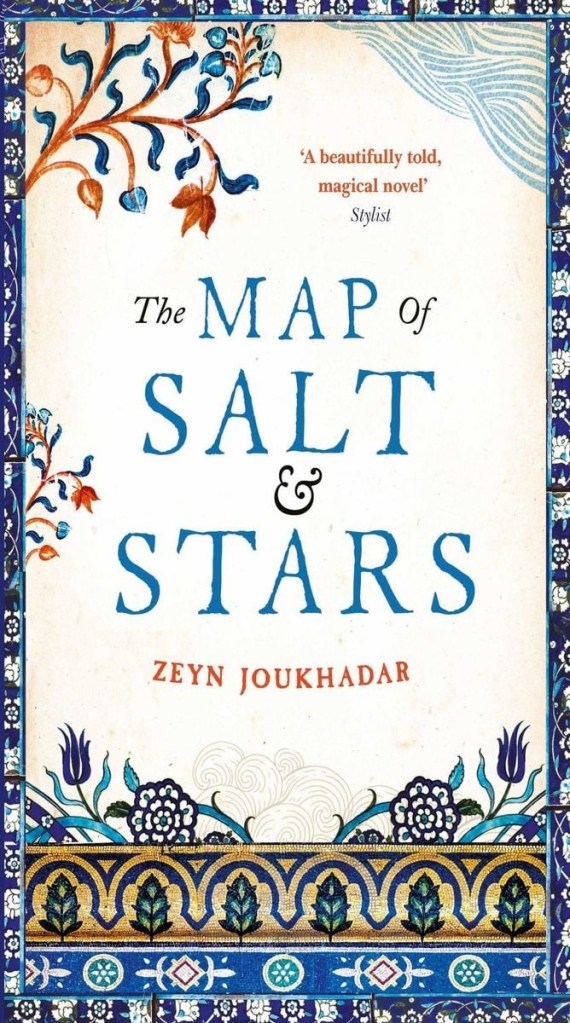
The Desert and the Drum

šŸ“ Mauritania šŸ‡²šŸ‡·

Mauritania is a sovereign country in Northwest Africa. It is the 11th-largest country in Africa, and 90% of its territory is situated in the Sahara. It achieved independence in 1960 from French colonialism but has since experienced recurrent coups and periods of military dictatorship. Despite an abundance of natural resources, Mauritania remains poor. It was the last country in the world to abolish slavery, in 1981, and criminalised it only in 2007. (Source Wikipedia)

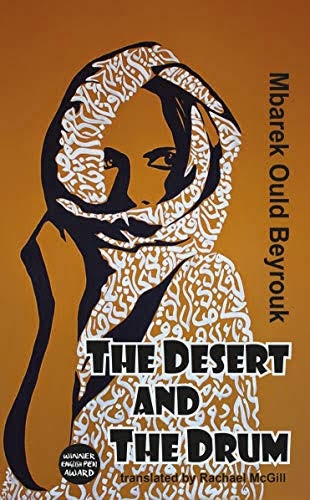
This book is the first novel ever to be translated into English from Mauritania. It was originally published in French in 2015 and translated by Rachael McGill in 2018. The book won the Ahmadou Kourouma Prize in 2016 (the prize was established in 2004 in honour of the Ivorian writer Ahmadou Kourouma, and it is awarded annually to works of fiction and nonfiction concerning Black Africa).

The story traces the journey of a young Bedouin girl, Rayhana, who has run away from her tribe and is on a mission to find the thing that has been snatched from her with force and deceit. While running away she has taken the sacred, symbolic and pious drum, rezzam, that belongs to her tribe and represents their pride and honour. She embarks on this perilous journey through the unforgiving Sahara and reaches a small town, Atar, and finally to the capital, Nouakchott. During this sojourn, she encounters various people who help her in their own ways, in achieving her mission, and also protect her from her tribe who are in search of her to retrieve their prized drum. Standout characters include that of the slave girl, Mbarka, who has now become a sex worker; and the very colourful and jovial queer guy, Hama.

The book is a raw, unapologetic and uncomfortable narrative of Rayhana’s turmoil. The chapters oscillate between the past and the present as does Rayhana’s thoughts from her secure yet stifling existence in her tribe, to the unknown and unwelcoming mores of the city life. She is torn about the fact that, she still cradles the belongingness she feels towards her tribe whilst despising the carefree and untethered cultural values of the city. She still remains a prisoner of her unpropitious upbringing, though freedom is now within her reach.

The author, Mbarek Ould Beyrouk, originally from Atar, is a journalist, who has written four books and has founded the country’s first ever independent newspaper. He gives an honest portrayal of the Bedouin life and their customs, and has kept the story rooted in Mauritanian ethos. The issues of patriarchy, misogyny, gender based violence, caste based oppression aren’t exclusive to Mauritania. Let’s get off our high horse, shed our condescension and pomposity, and examine the issues closely. They are as much prevalent behind the faƧades of glitzy high rises and modern lifestyles as they are in the humbling desert.

~ JUST A GAY BOY. 🄹

Magpie Murders

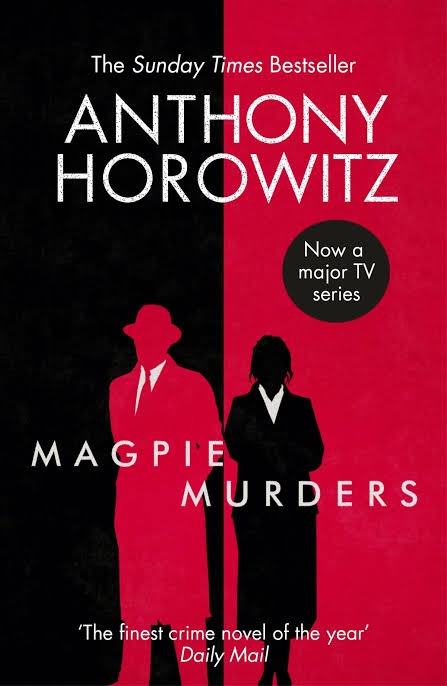
This book is so indescribably clever. It’s a book within a book, mystery within a mystery. The plot is incredibly intelligent, so much so that, trying to give a synopsis of it, would be a complete killjoy and a spoiler. After a really long time, I have come across a murder mystery that’s taut, sharp, compelling and a page turner from the word go. The narrative is atmospheric whilst the attention to detail is phenomenal. The language used is rich, articulate and eloquent. And for once, there isn’t a damaged and dysfunctional woman as a protagonist here. Thank you, Anthony Horowitz, for bringing the joy back to reading thrillers and for keeping it so unpredictable. Also, can’t thank Read a Kitaab Bookclub enough for picking this gem as their December Book of the Month. Now, I can’t wait to read the next one in the series; Moonflower Murders.

Must, must read.

~ JUST A GAY BOY. šŸ‘

The Seven Moons of Maali Almeida

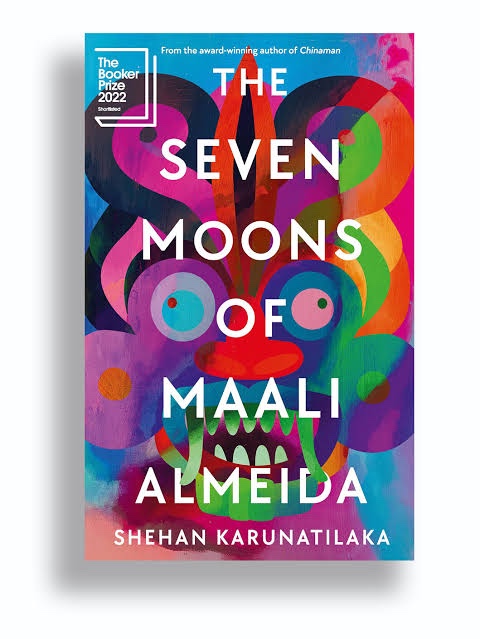
This 2022 Booker Prize winner book is like no other. The protagonist, Maali Almeida is dead. He has been killed and his body dumped in Colombo’s Beira Lake. His ghost is now narrating the story and trying to find out his killer/s. The premise is happening in the very nebulous In Between, wherein ghosts are looming large over Colombo’s skyline and constantly trying to interact or distract the living mortals Down There. If this has intrigued you already, wait till you read the brilliance with which Shehan Karunatilaka has authored this story. It is set in the extremely turbulent times of Sri Lanka’s civil war circa 1989. Maali is a war photographer who clicks unfiltered, raw and controversial photos of war victims, ruthless politicians and the civil unrest per se. Debauchery forms his middle name, as he parties with Colombo’s elite and canoodles countless young men. Now that he’s dead, he’s got ā€œSeven Moonsā€ to sort out his grievances. He tries desperately to reach and send signals to his people Down There, especially his best friend Jaki and his on-off boyfriend DD. Other ghosts inadvertently and reluctantly help him with this pursuit. As Maali finds out his killer, whilst protecting the war photographs that could expose the dirty politics of the country, he also tries to make amends with all his strained relationships, albeit, its now in the afterlife.

This roller coaster of a story gains momentum from the start and constantly shifts between the past and present; real and otherworldly. Shehan doesn’t shy away from presenting the gory details of the politics behind the war using satire and dark humour; at the same time also blasphemously portraying the privileged ignorance of other countries and international organisations in mindlessly sustaining the war. The mastery of his writing is evident in the way he has fleshed out Maali’s character who you want to sympathise with just because he’s dead but are also put off by his arrogance, audacity and impetuous attitude. The nuanced portrayal of the various messy relationships between the characters and their interplays in the backdrop of a war and an afterlife is ingenious to say the least. Shehan has been able to translate the palpable frustration of Maali in us as his ghost looks arounds furtively and helplessly for answers. Also, very rarely do you come across such an effortless writing which doesn’t take sides despite a raging war, countless deaths, and a humanity at loss.

Stellar!

~ JUST A GAY BOY. 🤩

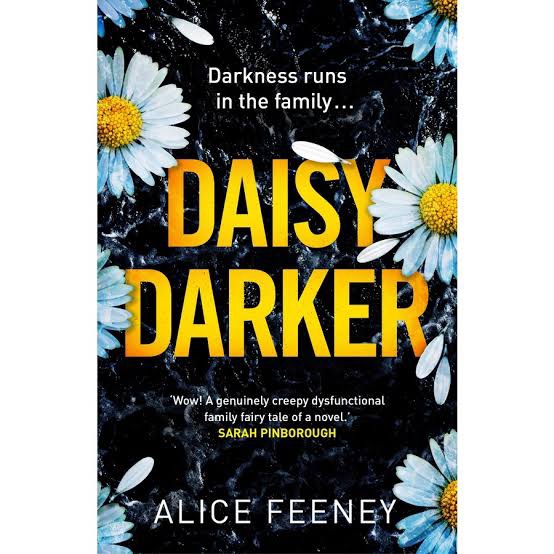
Daisy Darker

Daisy Darker, the protagonist, is born with a broken heart. And now, she has come over to her Nana’s house, Seaglass, for her eightieth birthday which also doubles up as a family reunion. Her estranged family, which includes her parents who are divorced, her two elder sisters and her niece all land up at Seaglass one after another. Seaglass is an old house on the Cornish coast, on an isolated island at the bottom of a cliff that’s only accessible at low tide. As the night progresses, Nana lays out her feast and reads out her will, which displeases all of them. Soon, someone is found dead. This is followed by more murders with every passing hour. Nobody is able to leave the house till sunrise because of the high tide. Everyone who hasn’t been murdered is frantically trying to save themselves whilst also trying to find out the killer.

The above plot does seem very intriguing and has been written in a gripping manner. However the climax is a major letdown. Honestly it’s laughable and extremely frustrating. The explanation for all the killings is so simplistic and so juvenile that you end up feeling exasperated for the author having wasted your time. How is this book even a best-seller? Who are these people who are liking this idiotic mystery?

Total trash! Avoid.

~ JUST A GAY BOY. 🤬

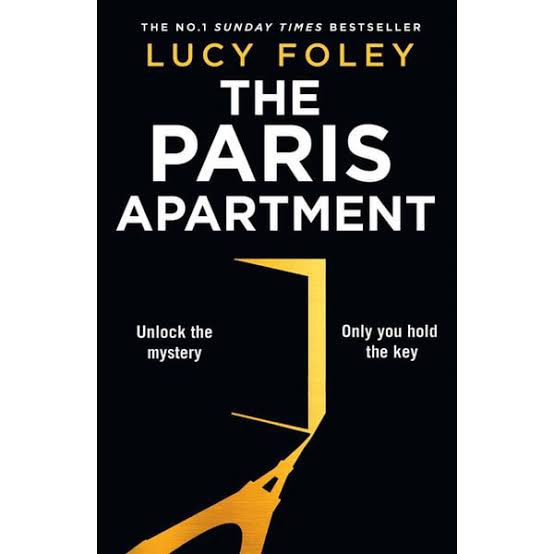
The Paris Apartment

Lucy Foley’s latest is another one of her slow burn thrillers that keeps you hooked till the last page. This time the story is set in the stylishly seductive city of Paris. The main protagonist, Jess, has run away from her dysfunctional and troubled life back in London. She has come to Paris to be with her brother Ben, who has always maintained a distance from her. She lands in Ben’s uber luxurious apartment located in the most upscale neighbourhood of Paris, only to find him missing. As time passes by, Jess begins to worry and starts searching for her brother with whatever little clues she’s able to decipher. She finds herself in the midst of extremely unfriendly and brusque neighbours who vehemently refuse to divulge any details regarding him. She begins to wonder if Ben is even alive and suspects each one of the residents of this Paris apartment, responsible for his disappearance.

The story has all the requisite elements, making it an edge of the seat thriller. The narrative is told from each of the characters’ viewpoint. The setting is atmospheric and deliberately dark. Paris becomes this silent hum in the background and its mysterious beauty etched ever so beautifully in Lucy Foley’s writing. The climax, just like her previous book, The Guest List, did make me wanting for more; but nonetheless, it’s definitely worth the read.

~ JUST A GAY BOY. 🫣

Kurdish Women’s Stories

šŸ“ Kurdistan

Kurdistan is a roughly defined geo-cultural territory in Western Asia wherein the Kurds form a prominent majority population. It comprises the following four regions: southeastern Türkiye (Northern Kurdistan), northern Iraq ( Southern Kurdistan), northwestern Iran (Eastern Kurdistan), and northern Syria (Western Kurdistan). Certain Kurdish nationalist organisations seek to create an independent nation state while others campaign for greater autonomy within the existing national boundaries. Iraqi Kurdistan first gained autonomous status in a 1970 agreement with the Iraqi government, and its status was reconfirmed as the autonomous Kurdistan region within the federal Iraqi republic in 2005. There is also a Kurdistan Province in Iran but it is not self ruled. Kurds fighting in the Syrian Civil War were able to take control of large sections of northern Syria and establish self governing regions in an Autonomous Administration of North and East Syria (Rojava). [ source: Wikipedia]

This book is an anthology of 25 stories, told by Kurdish women themselves. The book spans five generations and starts with the oldest woman and ends with the youngest. There are voices from each of the four regions of Kurdistan. The book is a nuanced, poignant, first person account of the lives of Kurdish women, a nation without a state; fighting authoritarian governments, patriarchy, discrimination and gender based violence. But more importantly, it’s an inspiring and reverberating narration of the resilience, courage, determination of these fierce and independent Kurdish women. These valiant women wore their Kurdish patriotism and pride on their sleeve and fought for their region through art, poetry, education, whilst braving grief due to death and separation from their loved ones. None of the women, in these stories portray themselves as victims, despite the adverse circumstances; instead only speak about their outstanding valorous actions in an understated and pragmatic way. The stories edited and put together by Houzan Mahmoud, is a testament to the brave, crucial and exceptional women revolutionists and crusaders who are often forgotten by the media and the world at large.

~ JUST A GAY BOY. šŸ‘

The Ardent Swarm

šŸ“ North Africa

Tunisian author, Yamen Manai’s book, translated from French by Lara Vergnaud, is brooding and contemplative. This wonderful parable, can seem deceptively simple but is a rich tapestry of human emotions and behaviours. The story takes place in a far flung village of Nawa. Sidi, the beekeeper of the village, has devoted his life in taking care of his precious honeybees. However, one day when he finds them brutally massacred, he sets out on a quest to find the perpetrators behind the attack. He soon reckons that hornets are responsible for it and takes it upon himself to safeguard his bees from the menacing and dangerous hornets. At the same time, the unnamed country is going through a new post-Arab spring transition which sees the rise of radical fundamentalists to power. Using God, they are on a mission to convert the people into a bunch of zealots. As Sidi, grapples with the changing sociopolitical scenario and attitudes of people, juxtaposed with the imminent threat to his bees due to a natural predator, he comes to a realisation that human beings are far worse and vicious.

It won’t be too difficult to draw parallels, with the current political situation in our country. As zealotry and jingoism take centre stage, God has been weaponised to spread hatred, bigotry and radicalism. Is this going to be a massacre of our humanity?

~ JUST A GAY BOY. šŸ˜”šŸ

The Other Black Girl

This book is supposed to be a thriller. Instead, it’s weird and atrociously lengthy. I was thrilled that, the writer decided to stop writing and finished the book. The book is about a Black girl, Nella Rogers, working in an all white publishing house, Wagner Books, in Manhattan. Being the only Black person at her workplace, she constantly faces racist micro aggressions on a daily basis. However, when another Black girl, Hazel, joins Wagner Books, things start going askew for Nella. Hazel’s popularity keeps growing as she befriends all the white people at the workplace including Nella’s boss. At the same time, Nella starts receiving mysterious notes asking her to leave Wagner. Nella finds herself in this emotional and social conundrum, wherein she needs to unearth Hazel’s true intentions whilst making a desperate attempt to safeguard her job and relationships.

As much as the author tries earnestly to have a very nuanced social commentary on the realities of Black people; the racism and bigotry being a part of their everyday lives; it all gets muddled in the tedious and slow paced narrative. Nothing worthwhile happens till about 300 pages. Then suddenly, we readers are rushed into a chaotic, insipid climax which honestly I didn’t even understand. The book has other subplots too, which are abruptly abandoned. Yes, the book celebrates Black culture and language in all its glory. Yes, it’s heartening to see Black women to be the protagonists of a book. But, where is the story? Where was the editor? After reading the book, I was wondering, if I was missing something, since online reviews for this book by leading media agencies have been stellar. Later, upon reading countless reviews by Black readers, especially women, who have shared similar opinions as to mine, I decided to write this.

Interestingly, if we were to reimagine this book in an Indian context, and have a Dalit-Bahujan protagonist, the similarities would be uncanny.

~ JUST A GAY BOY. 🄓🄱

The Bride of Amman

šŸ“Jordan šŸ‡ÆšŸ‡“

This debut novel by the Jordanian writer, Fadi Zaghmout, originally written in Arabic (Aroos Amman), later translated into English by Ruth Ahmedzai Kemp, caused quite a stir when it was released. Understandably so, considering the bold and controversial issues it explores, which are often deemed taboo and blasphemous in the traditional Jordanian society. The story is told through five characters of Leila, Salma, Rana, Hayat and Ali; all living in the capital city, Amman. Through these stories, the author tackles the persistent and pertinent issues of patriarchy, misogyny, chauvinism, incest, rape, sexual abuse, homophobia, widely prevalent in the conservative Arab community. An Arab woman’s worth is equated with her ability to get married at the right age, be a dazzling bride and bear children, especially sons. Her career and education are just an ornament. Zaghmout repeatedly asserts how women have no authority or agency over their own lives and bodies, and their choices are subject to male dominance and approval. Particularly disturbing story is that of Hayat, who is raped and sexually abused by her own father; later chooses promiscuity with multiple married men to escape this horrid truth.

Zaghmout’s narrative is a poignant reflection of contemporary Amman, however, I felt, that at many instances, he has tried to infantilise the grave problems. Hayat, as a rape survivor, is shown to forgive her father for his unpardonable crime. Her choice of being promiscuous seems to be very flippant and it seems as the only way a woman can get over her sexual abuse past. Ali, a closeted Iraqi gay man, gets married to Leila, has a child, and continues to have gay sexual encounters on the sly. Leila later discovers his homosexuality and upon confrontation, chooses to accept her life as his wife, devoid of sex, delves steadfast into her career and turns a blind eye to his indiscretions. In the book, the men are forever exonerated for their crimes and wrongdoings, by the women. There’s always some ā€œlogicalā€ reasoning to the way the men have behaved. This almost invisible, subtextual chauvinism can’t be ignored. Also, other than Salma’s story, the others seem to have the proverbial happy ending. This smacks of immature writing.

Majority of Indian gay men remain closeted and continue to have heterosexual marriages and children under the pretext of parental pressure and culture. They also have multiple gay liaisons after marriage with gay abandon (no pun intended) and literally no remorse. Are the Indian women too, like Leila, choosing to not see the obvious because of the pressure to stay married and the stigma of divorce? Or are they truly oblivious?

Though the book is about Ammani women, one can’t miss the fact, how close this hits home. Indian women, are still governed by the cis men around them, and it remains an ongoing struggle for them to establish their equality and agency.

~ JUST A GAY MAN. 🄺

The Accusation: Forbidden Stories from inside North Korea

šŸ“ North Korea šŸ‡°šŸ‡µ

This book has shocked me like no other. I am still astonished about the fact that, there still exists a country in this world like North Korea. A one of its kind country which has the lives of it’s citizens staged. A country where the autocratic leaders expect performances and accolades from their ā€˜captive’ citizens for simply existing in their thrones. A country which denies and violates all human rights, is akin to an open air prison.

Bandi, meaning firefly, is the pseudonym for the North Korean writer who might still be living under the oppressive regime. The book, shrouded in controversy over its origins, was written from 1989 to 1995, and was eventually published in 2013 in South Korea, and was later translated by Deborah Smith. The process involved in its publication which included smuggling the clandestine manuscript out of the country was an adventure in itself.

The book is a collection of seven short stories, the underlying theme of each being misery. What makes it even more heart wrenching is the fact, that the miserable and oppressed North Koreans can’t even utter a word about it, let alone against it. The autocracy has cast such a spell on everyone that many are unable to even recognise their plight and suffering. For them, this is the normal way of life. Two stories stood out for me. In So Near, Yet So Far, a young man Myeong-chol is desperate to see his ailing mother who is in a remote village, but is denied permit to visit because of a Class One event. Despite his futile attempts to hoodwink the authorities, he’s unable to see his mother and ultimately ends up in a torture prison. In the story, The Red Mushroom, Hoe Yunmo, is a newspaper reporter, who has been entrusted with writing an article on N town’s bean paste factory returning to normal production levels. However the truth is starkly different. During his investigation he discovers the deplorable conditions of the workers involved but is never able to write about it. The story portrays a writer’s helplessness and frustration in North Korea.

The book can be an eye opener for us. North Korea prides itself on its totalitarian leadership and propaganda. As you read the book, you get an idea, that other than the capital, Pyongyang, the rest of the country is battling severe famine, malnutrition and disease. However, propaganda by the Great Leader and the media, paints a completely different picture. If we contemplate, it won’t be too difficult to draw parallels with our own present situation. We are voting for propaganda, hailing religious sentimentality and jingoistic media and journalists, centering divisive rhetoric, celebrating non performance disguised under the veil of fanaticism and radicalism; and dismissing democracy, criticism, opinions, and humanity at large. Are we under a spell too? Is there a way out?

I hope every Indian reads this book.

~ JUST A GAY BOY. 😧