Sista!

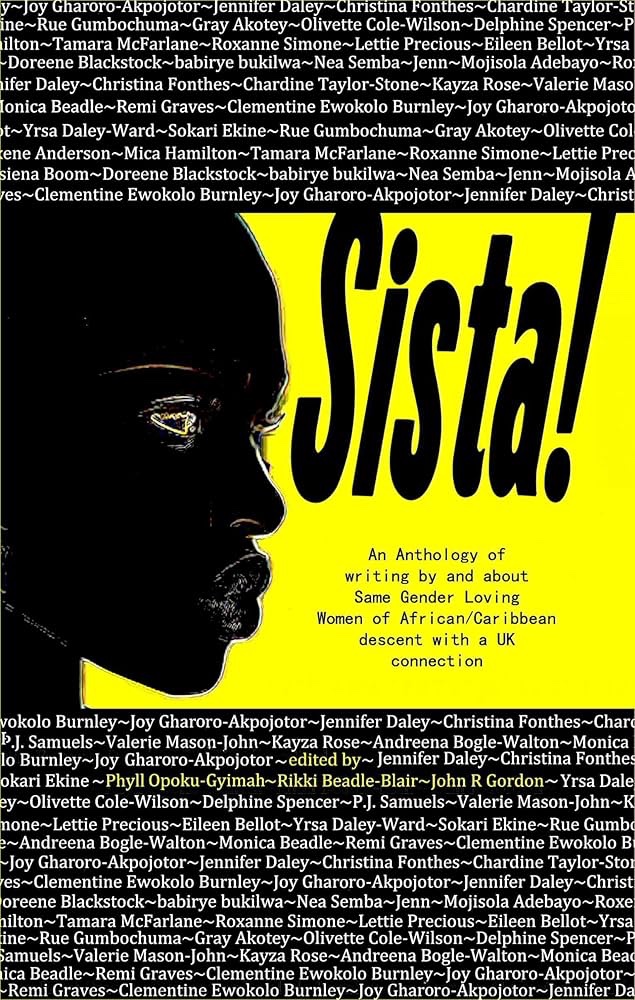
If you have read Black women writers, you would know that their writing is fierce, inspiring, creative and bold. They write with compassion and conviction, almost always to uplift one another and nurture the sisterhood, especially Black sisterhood. You can only imagine how much more intense and interesting the writing becomes when an anthology brings together a constellation of queer Black women writers. As the cover promises, Sista! is a brilliant collection of stories, poems, personal essays, (and even an interview) by and about queer women of African and Caribbean descent  with a connection to UK. 

While every contribution deserves recognition, a few pieces stood out to me for their authenticity, enviable audacity, and the incandescent freedom that radiated from their words. They are as follows:

  1. In her deeply personal essay, Not White, Not Ever: a Black Lesbian Lament, Kesiena Boom, a mixed-race, Black, lesbian feminist writer, reflects on the trials and tribulations of dating white women, and how race can be both, a catalyst to bring people together and one that also separates them, but can never be ignored. She also describes her failed attempts at having relationships with Black women and wonders what it takes for Black lesbians to seek and sustain romantic relationships and whether the overtly white lesbian landscape itself becomes a deterrent for Black women in visualising and creating meaningful partnerships.
  2. Author of 8 books and an inspirational Public Speaker, Valerie Mason-John’s Those Were The Daze, is a heartfelt rendition of what it means to be an elder of the Black Queer community. She revisits her struggles as a lesbian in the 80s including how her accidental coming out created both opportunities and hardships. She carefully explains her arrogance then which she adopted as an armour to tide over the anti-queer sentiment and reminds us in the most blistering way, how now more than ever, queer communities and queer people must look beyond racial, ethnic, religious and other socioeconomic differences and soldier on together as a singular powerful force.
  3. Tamara McFarlane’s poems are tender and evocative, with an equal measure of romance, sensuality and poignancy.
  4. Nea Semba’s tour de force essay, Supermalt, Self Love and Sexuality, is a rambunctious celebration of Black womanhood and the intersections between Black and Queer feminism. In this carefully constructed piece, the author, a non binary queer African, describes the significance of Black woman’s hair as an expression of her independence, authority, Blackness and queerness. Semba also confronts uncomfortable truths, including the persistent perception of queerness as a white thing and the tendency to attribute homophobia solely to religion while overlooking the roles of toxic masculinity and colonialism.
  5. In To be Femme: Lesbian Guerrilla Soldier, Chardine Taylor-Stone, an award winning cultural producer and feminist activist, succinctly elucidates what it means to be Femme and how embodying it as a queer woman of colour can itself be a radical act of feminism.
  6. Nigerian-British writer and visual scholar, Sokari Ekine’s Love in the Age [of] Evolution, is a hopeful and deeply moving reflection on dating, intimacy and discovering love at the age of 67. The essay brims with excitement and euphoria but simultaneously brings in the reality of dating with maturity and intention. She strongly asserts against the notion of age being considered a disability in the cis-normative world and how Black queer women are changing this very notion with their zest for romance, desire and companionship.

Sista!, edited by Phyll Opoku-Gyimah, Rikki Beadle-Blair and John R Gordon, is an illuminating anthology about lives and experiences that may initially seem distant from our own, but through them they reveal universal truths about reclaiming authority, autonomy and agency. The women writers bring in their unfiltered voices portraying their vulnerability and resilience and aren’t afraid to conceal their mistakes and shortcomings. The stories embolden us with extraordinary power, inviting us to restructure and recalibrate our own lives. They emerge from moments of existential crisis, yet arrive at places of balance and affirmation.

Few anthologies possess the ability to alter the way we see ourselves and the world. Sista! is one of them. It has the potential to change you at the molecular level, not because these writers set out to transform you, but because their stories have that innate ability to accomplish that quietly and organically. 

I end the review with this quote from Kayza Rose’s essay, When is the right time?,

I do hope we will come to a time where ‘coming out’ isn’t needed, and that being SGL (same gender loving) will be one of the norms of society. We still have a long way to go… but I do hope!

~ JUST A GAY BOY. 🏳️‍⚧️🏳️‍🌈

Assembly

A Black British woman whose family is from Jamaica, has had a good education and is now working as a financial executive in London who’s slated for a promotion. She has a white boyfriend whose family has an estate and has been bestowed with ancestral wealth. She is hesitant to attend the boyfriend’s parents’ anniversary party at their estate over the weekend. The boyfriend adores her and is excited to introduce her to his family. Now, from the outside, everything seems like a dream and the narrator is seemingly living the proverbial good life. Is she really?

Assembly is an internal monologue of the narrator as she goes about living her life. A life that appears perfect to the world, is in actuality, diametrically opposite to it. The narrator visualises herself and her life through the racial constructs of an apparently colourblind society only to find it hypocritical and dismissive of her struggles and lived experience. Colourism and chauvinism come disguised as diversity that beguilingly disregards her competence and contribution. Microaggressions become insidiously inherent part of her personal and professional relationships. Her existence always gets measured by her achievements and simultaneously the same achievements get scrutinised for their authenticity and credibility. The narrator is forever filtering and self editing her thoughts and actions leading to an unconscious reaction or an instinctual internal censoring. This habitual silencing results in extreme frustration, repressed emotions, distress, resentment causing alienation, emotional dysfunction and cognitive dissonance. 

Natasha Brown’s Assembly is a brave new voice in the world of literature that is trying to dismantle racism and colourism. The acerbic rhetoric feels like a whiplash at times. The brevity of the writing is no hindrance to the profundity each word provides to the central issue. Brown’s economy of language is a reflection on the stifling effects of racism on consciousness and conditioning. However, despite the meritocracy, I did find the rendition a tad flawed, especially when the narrator gets diagnosed with a disease. I couldn’t help but wonder, the necessity of that incident and also the intention of the author behind it. Was the disease introduced as a way to mollycoddle the readers into sympathising with the narrator and to align us with her complicity? Was it an easy way out for the author to refrain the readers from taking a stand against the narrator for the choices she never makes and for her perpetual rumination on society’s racism? Was Natasha Brown subtly illustrating the physical toll of suppressed anger and racial frustration? I know my opinion does appear controversial, but I wouldn’t have minded the narrator’s connivance, hesitancy to question and non confrontational stand, because she’s the victim of covert racism and that is something, that is always deemed speculative and unsubstantiated. So though we readers would have wanted the narrator to take a stand, to pacify our unsettled emotional core, we need to ask ourselves, if the narrator had a choice. And if she did have a choice, could she have executed it and at what cost? Hence, I wonder again, if Natasha Brown was deliberate in sugarcoating the narrator’s helpless reality. 

Nonetheless, keeping my nitpicking aside, I do strongly recommend Assembly

~ JUST A GAY BOY. 😐

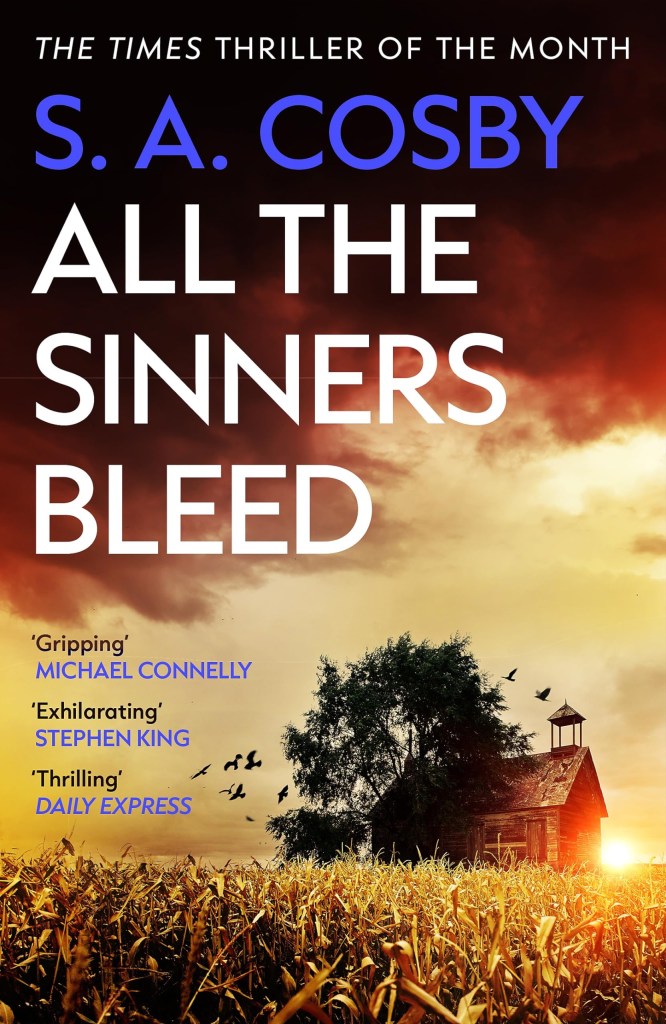
All The Sinners Bleed

Former FBI Agent, Titus Crown, has returned his hometown, Charon County in Virginia, to become its first Black Sheriff. In a county, that has sixty percent Black population, racial tensions simmer and white supremacists’ zealotry looms large. He often finds himself at crossroads of doing the right thing of upholding the law and protecting the lives and rights of the Black community whilst ensuring that no one under his jurisdiction, irrespective of their race gets mistreatment or preferential treatment. His judgement and authority are put to test when there occurs a school shooting, wherein a black boy, Latrell, shoots county’s beloved white teacher, Mr. Spearman in public. Latrell is soon shot at and killed by Titus’s deputies when they see him raging, and assume him to be out of control and threat to everyone. The investigations following this incident, lead Titus and his team to a graveyard where the bodies of seven Black and Brown teenagers are found to be buried. Further probing makes Titus speculate the connections between the gruesome murders of the children, Latrell and Mr. Spearman, while also discovering the involvement of another person, who he nicknames as ‘The Last Wolf’, and soon believes to be the principal orchestrator of the murders.

Apart from the murders of the children, the book also features killing of two other characters in the most grotesque, violent and disturbing manner. Titus is faced with the urgency and obligation of catching the serial killer while the county and its people start doubting his ability of doing his job satisfactorily and impartially. At the same time, he is burdened with his own internal monologue about his relationship with his girlfriend Darlene, his bond with his estranged brother Marquis and the real reason for him leaving the FBI. 

The plot is intriguing, the writing is engaging that keeps the readers hooked with the requisite twists and turns. However, things become tedious because of multiple subplots and umpteen inconsequential characters. The author seems to have lost his way through this complicated narrative of myriad happenings and fails to provide resolution to any of them. The climax is a letdown especially since it happens suddenly after the forever meandering on the innumerable murders and Titus’s never ending investigation. Also, the reveal of the murderer is tepid and their motive feels superfluous and incongruent with the brutality of the murders committed.

S A Cosby is a prolific Black writer and this book was my pick for Black History Month. He specialises in the ‘Southern Noir crime fiction’ genre and has received several awards for his writing. He has centred race and geopolitical issues in his work and All The Sinners Bleed, is no different. In this book too, racism remains the subtext. Through his titular character Titus, he takes the opportunity to educate and inform everyone how racism is present and still can be missed; how bigotry and fascism can disguise themselves as ignorance. Cosby’s authoritative Black voice lends gravitas to the forgotten Black History and the contemporary Black issues. If only he had also paid equal attention to the mystery that was supposed to be present in a murder mystery.

All The Sinners Bleed is a proverbial thriller that never had me thrilled. I was thrilled when it was finally over.

~ JUST A GAY BOY. 🕵🏽

The Other Black Girl

This book is supposed to be a thriller. Instead, it’s weird and atrociously lengthy. I was thrilled that, the writer decided to stop writing and finished the book. The book is about a Black girl, Nella Rogers, working in an all white publishing house, Wagner Books, in Manhattan. Being the only Black person at her workplace, she constantly faces racist micro aggressions on a daily basis. However, when another Black girl, Hazel, joins Wagner Books, things start going askew for Nella. Hazel’s popularity keeps growing as she befriends all the white people at the workplace including Nella’s boss. At the same time, Nella starts receiving mysterious notes asking her to leave Wagner. Nella finds herself in this emotional and social conundrum, wherein she needs to unearth Hazel’s true intentions whilst making a desperate attempt to safeguard her job and relationships.

As much as the author tries earnestly to have a very nuanced social commentary on the realities of Black people; the racism and bigotry being a part of their everyday lives; it all gets muddled in the tedious and slow paced narrative. Nothing worthwhile happens till about 300 pages. Then suddenly, we readers are rushed into a chaotic, insipid climax which honestly I didn’t even understand. The book has other subplots too, which are abruptly abandoned. Yes, the book celebrates Black culture and language in all its glory. Yes, it’s heartening to see Black women to be the protagonists of a book. But, where is the story? Where was the editor? After reading the book, I was wondering, if I was missing something, since online reviews for this book by leading media agencies have been stellar. Later, upon reading countless reviews by Black readers, especially women, who have shared similar opinions as to mine, I decided to write this.

Interestingly, if we were to reimagine this book in an Indian context, and have a Dalit-Bahujan protagonist, the similarities would be uncanny.

~ JUST A GAY BOY. 🥴🥱