The Woman in the Purple Skirt

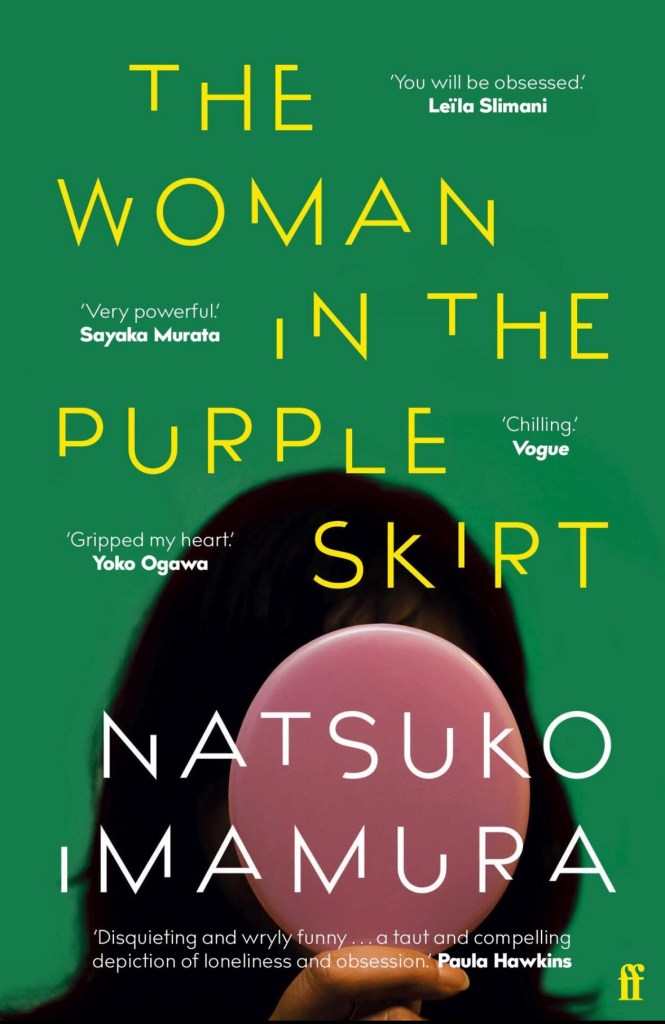
My pick for Read a Kitaab’s #januaryinjapan was, ‘The Woman in the Purple Skirt’. The book, written by the acclaimed Natsuko Imamura and translated from the Japanese by Lucy North, has garnered fairly positive reviews online, however I was left feeling disappointed. The book is about this eponymous Woman in the Purple Skirt who is being closely watched by the narrator who calls herself as the Woman in the Yellow Cardigan. She meticulously describes every move of the woman in the purple skirt, her daily routine, eavesdropping on conversations and even gets her a job in the hotel that she’s employed at. Despite this extremely voyeuristic snooping by the woman in the yellow cardigan, she remains inconspicuous and almost oblivious to the other woman. However, things take a more ominous turn after the woman in the purple skirt starts working earnestly in the hotel and the sequence of events leading upto the climax happen so rapidly, it almost feels like an antithesis to how the book began.

In summation, I felt the climax to be a major letdown despite the foreboding atmosphere it created and the thrilling subtext. Though the book discusses themes of loneliness and the yearning for a friendship, and the human need to be seen and validated, it gets lost in the narrative that remains hyper focused on the inconsequential daily mundane activities of the woman in the purple skirt for the greater part of the book.

Ultimately, I even wondered what was the purpose of the woman in the purple skirt? What was the author trying to convey? I remain discombobulated!

~ JUST A GAY BOY. 🫤

Minor Detail

📍 Palestine 🇵🇸

This novel has two parts. The first one is set in the year 1949, just after the Nakba of 1948. An Israeli officer is scouring the Negev desert for any remaining Arabs or Arab settlements. The blistering heat, a festering infection, dust, sweat do not deter him from going about his day in a regimented way. His single handed determination to find Arabs does lead him to a Palestinian girl, who is forcibly brought back to the Israeli military camp, where she is gangraped by the soldiers, later killed and buried in the sand. The second part, begins in the city of Ramallah, where a young Palestinian woman sets out to investigate this crime that happened 25 years ago. As she juggles her way through the innumerable military checkpoints in the West Bank and on her journey to the desert, she is also juggling anxiety and panic that have become ubiquitous in her life due to the Israeli occupation. Her single handed determination to find details about the gruesome incident despite the unforgiving heat through the lonesome desert unfortunately leads to a tragic penultimate moment.

The book is an uncomfortably simple yet unflinchingly honest prose on Palestine and Palestinian people living under the occupation and an apartheid regime. The first half focusses on the daily mundane activities of the officer over and over again, so much so that the brutality that occurs becomes a part of the same mundane. In the second half, the author literally places us in the passenger seat of the woman as she takes on the perilous journey, and we get to experience first-hand her anxiety, fear and trauma muddled in her determination and longing to unearth the truth. The author deftly shifts the narrative perspective from the Israeli officer whose intention and purpose is annihilation of Palestinians, to the Palestinian woman whose reality is obscured and dependent on the military occupation. Freedom is villainous in one while it’s the prisoner in another. Life is precious in one while for the other, death is a close ally.

Adania Shibli is a Palestinian author and essayist, born in Palestine, who has written three novels and lives between Jerusalem and Berlin. Minor Detail, translated from Arabic to English, by Elisabeth Jaquette, was longlisted for the International Booker Prize in 2021 and was also nominated for National Book Award for Translated Literature in 2020.

As of December 11th, 2023, over 17997 civilians which include 7729 children have been massacred in Gaza since the genocide began on October 7th, 2023. The dehumanisation of the Palestinian people by the entire world has never been more stark and atrocious. The global silence on the oppressed and the selective empathy towards the oppressors is a new abysmal low for our collective humanity. The total disregard towards the ethnic cleansing of the Palestinians, the absolute subservience towards the Israeli propaganda of self defence, the failure to distinguish between antisemitism and zionism is a telling of the dark times we are in. The next time when the world’s so called superpowers call for peace and human rights, you can gawk at the irony of it.

~ JUST A GAY BOY. 🇵🇸

A General Theory of Oblivion

📍 Angola 🇦🇴

Angola is a country on the west central coast of Southern Africa. It is the second largest Portuguese speaking (Lusophone) country in the world. After a protracted anti-colonial struggle, Angola achieved independence in 1975 from Portuguese colonisation as a Marxist-Leninist one party Republic. The country descended into a devastating civil war the same year between the ruling People’s Movement for the Liberation of Angola (MPLA), the insurgent National Union for the Total Independence of Angola, and the militant organization National Liberation Front of Angola. The country has been governed by MPLA ever since its independence in 1975. Following the end of the war in 2002, Angola emerged as a relatively stable unitary, presidential constitutional republic. (Source- Wikipedia)

The book, originally written in Portuguese by Angolan writer, José Eduardo Agualusa in 2012, was translated into English by Daniel Hahn in 2015. The novel appeared on the shortlist for the 2016 Man Booker International Prize and has been the recipient of the 2017 International Dublin Literary Award. The story is about a woman, Ludovica, who seals herself off in her apartment in Luanda in 1975 at the time of Angola’s independence. As Luanda plunges into a civil car soon after, Ludovica watches it unfold in bits and pieces through her window, radio and sometimes overhearing people’s conversations. She’s also dealing with the abrupt disappearance of her sister and brother-in-law which happens around the same time. She sustains herself frugally by growing her own vegetables, catching pigeons, reading the books in her house and by scribbling her thoughts on the wall. Years pass by, and Ludovica, with her aging and diminishing eyesight often oscillates between periods of imagined insanity and hopeless reality. One day, a little boy, Sabalu comes into her life, at a time, when she’s immobile and sprawled out on the floor due to a fracture. He tends to her and gives her hope through his unconditional empathy and care. Just when Ludo starts considering Sabalu as her grandson and only family, she is confronted with an unexpected and unknown family member.

This dark and seemingly despondent life of Ludovica runs in parallel with the civil upheaval in Luanda and Angola. The author also introduces us to a myriad of other characters through the narrative, whose individual stories, purposes and intentions come together in the end. Each of them has a tale woven across Angola’s independence. He also takes time in explaining Ludovica’s painful past traumas leading her to live a life of confinement, self abandonment and shame.

Agualusa’s prose is purposeful, political and poetic. He crafts a meandering plot that traverses from Angola’s independence in 1975, through the civil war, till its end in 2002. He doesn’t shy away from layering the text with mentions of colonialism and white supremacy and it’s problematic effects. Ludovica comes across as a woman of steely grit having a resounding optimism to live, despite her circumstances and her own beliefs about her. That’s the genius of Agualusa’s writing. Do savour it.

~ JUST A GAY BOY. 🙃

Time Shelter

(spoilers ahead; mostly it’s my interpretation)

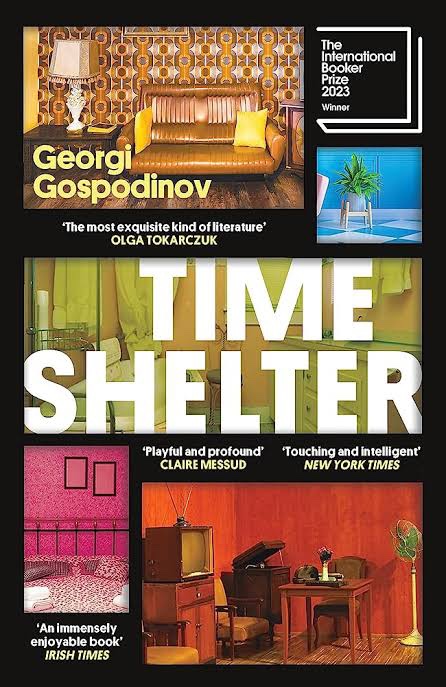
There’s a reason why certain books win the coveted International Booker Prize. Simply put, there isn’t a book like that; a writing like that, a story like that; that you would have read or ever come across. Time Shelter, winner of the 2023 International Booker Prize, is certainly one such book of course, but more than a book, it’s a collection of nostalgia, of memories; and of the times when these memories start fading.

The story is about a psychiatrist, Gaustine and an unnamed narrator. Gaustine opens a clinic for patients suffering from Alzheimer’s disease in Zürich. Each decade has been recreated in this clinic from the decor to the newspapers of that time. Patients come into the clinic, and through this memory evoking therapeutic sensory experience, start remembering, recognising and reliving the forgotten time. The narrator becomes fascinated, almost borderline obsessed with Gaustine’s ingenious idea and becomes a part of his team in building such clinics all across Europe. Before you know it, the entire world is now building these clinics, even planning cities dedicated to certain eras and decades. Countries have referendums on which past year or decade be chosen to be recreated. As with any fantastic idea, this ambitious project too, marred by its pomposity, soon starts to disintegrate into chaos and mayhem.

There was this surreal moment whilst reading the book, when the penny dropped for me. I realised the beauty of this book and the craftsmanship of the author, Georgi Gospodinov (masterly translated from the Bulgarian to English by Angela Rodel) in writing a tale like this. The author has exposed us to the mind of the narrator who is writing this book and who is losing his mind. Now what starts as a story soon morphs into his recollections and learnings of history and later into a series of uncoordinated events. We become witness to his dementia. We are put onto the edge of the precipice of an individual losing himself and his autonomy. This realisation jolted me, suddenly the book developed an eerie undercurrent because what I had thought to be benign till now, wasn’t really so. So I wondered, did Gaustine ever exist? Or was the narrator Gaustine?

The book is rich in Bulgarian and European history. The author juxtaposes this richness with the hypocrisy prevalent in European politics. His satirical narrative takes us on a raucous journey from World War II to Brexit. The author deliberately changes the writing style and language through the course of the book. What starts off as poetic, lyrical and contemplative in the beginning, later becomes tedious and monotonous, only to end disjointed. Through Time Shelter, Gospodinov, has attempted to highlight people’s obsession with the past, only so much as to stall the future whilst forever remaining oblivious to the present. Not an easy book to read for sure, but if you do read (which you must!), you can marvel at Georgi’s innate literary genius. Now let’s ruminate on the title. Goosebumps!

~ JUST A GAY BOY. 🥸

Crafting the Word: Writings from Manipur

📍 Manipur

The book is an anthology of short stories, essays and poems, many of which are translations from the Manipuri into English, all written and translated by women writers from Manipur; edited and put together by Imphal based independent journalist, writer and translator, Thingnam Anjulika Samom. Many prominent Manipuri writers feature in the book from the yesteryears to the current. Particularly noteworthy amongst them was Binodini, who was a Manipuri novelist, essayist, playwright, screenwriter and lyricist. Her collection of short stories in 1965 was the first by a Manipuri woman. Her story, Girls’ Hostel Sri Bhavana; translated by L. Somi Roy, evokes a sense of nostalgia and grips us with the tenderness of love and belonging.

The book begins with an elaborate and nuanced essay, The Journey of Women’s Writing in Manipuri Literature, by Nahakpam Aruna, on the various Manipuri women writers and their contributions to the craft and society at large. The writings in the book form a social discourse on the position of women and women’s rights in Manipur. Patriarchy, misogyny, abuse, gender and caste based discrimination, menstruation form recurring topics in the various stories and poems. Though every story is profound, three of them caught my attention. These are: 1) Sati interview by Ningobam Sanatombi, translated by Kundo Yumnam, which takes a very poignant and satirical look on women’s rights in Hindu mythology; 2) Nightmare by Nee Devi, translated by Soibam Haripriya, is a tragic lesbian love story wherein the lesbian lovers, Somo and Leishna, are at the receiving end of their respective homophobic and abusive families; 3) The Defeat by Ningombam Surma, translated by Bobo Khuraijam, which, through the story of a married couple, Bipin and Nalini, brings forth the hidden chauvinism present in the often revered so-called feminist men.

The writings are simple and the language lucid, but they pack a punch. The messages that they convey can keep echoing long after you have finished the book. Manipur is currently in a state of utmost unrest, turmoil and despair. I hold this book close to my heart whilst thinking about all the people there, especially the women and these brilliant women writers. May peace and stability reign.

~ JUST A GAY BOY. 🫥

Black Foam

📍 Eritrea 🇪🇷

This is a book like no other. The novel, written by Doha based Eritrean novelist Haji Jabir, was originally published in Arabic in 2018 and, is the first Eritrean novel to be longlisted for the 2019 International Prize for Arabic Fiction. It has been translated into English by Sawad Hussain and Marcia Lynx Qualey. The story is about an Eritrean soldier’s relentless pursuit in finding stability, hope and freedom as he traverses from Eritrea to Ethiopia to Israel. Adal fights as a soldier in The Eritrean war of Independence against Ethiopia and sees his country achieve it. While Asmara celebrates the new freedom, Adal changes his name to Dawoud, because he doesn’t want to be associated with it. During his time at the Revolution school there, his infractions lead him being sent to the torture prison at the Blue Valley. He escapes the prison to land in Endabaguna refugee camp in North Ethiopia where he becomes David. From there, he manages to enter the Gondar camp in the Amhara region of Ethiopia, posing as a Falasha Mura (Ethiopian Jew) named Dawit. This helps him in getting to Israel, finally to Jerusalem. This arduous journey which converts him from a soldier to a refugee, whilst he assumes various identities and religions, shakes him to his core; challenges all his beliefs and notions about the world and humanity. Ultimately, he finds a glimmer of solace when he visits the Al-Aqsa mosque in the West Bank region of Jerusalem, Palestine; it appears to him, as if life has come a full circle and there he starts questioning his identity and whether he may now be a part of a community of African Palestinians.

Black Foam is a composite story that, at the outset, through the protagonist’s character highlights the struggles and atrocities faced by a refugee. However, as we delve deep into the narrative, it holds your attention towards a plethora of unspoken issues and peoples. A nation’s independence needn’t necessarily attribute independence to all its citizens. As a soldier, Adal was left stifled living that life, though now Eritrea was free. However, his mindset was such that, he could never accept freedom, which led him from one refugee camp to another. The book also talks about the plight of Ethiopian Jews, who remain at the mercy of the Israeli Jews and live like second class citizens in the country. The story also talks about Palestine and lives of Palestinians living under the apartheid regime of Israel. Whilst weaving a sombre and at times discordant narrative through these complex geographies, the author simultaneously constructs the romantic and sexual life of the protagonist. This juxtaposition in the storytelling is distracting, deliberately pervasive and at times tedious.

Haji Jabir has masterfully sketched this story of a man in search of a home, security, a sense of belonging only to be met by hostility and uncertainty every step of the way. This quest is sadly the tale of millions of refugees in various parts of the world. Kudos to the author for writing it, keeping the despair and depravity alive in every page; for breathing life into the forgotten lives of the refugees; for portraying doom as a running subtext to the entire narrative. The descriptions of Jerusalem, West Bank, Al-Aqsa Mosque, Church of the Holy Sepulchre, is so detailed, nuanced; it’s almost as if we are there with Dawoud/ David/ Dawit as he roams these streets searching and questioning his life’s meaning and purpose.

Black Foam is a bittersweet melancholy that will stay with you long after you have finished reading it.

~ JUST A GAY BOY. 🥺

Rain and other stories

📍 Mozambique 🇲🇿

Mozambican writer Mia Couto is one of the most prominent Portuguese language writers of today. After studying medicine and biology, he worked as a journalist and headed several national newspapers and magazines in Mozambique. He has published more than thirty books that have been translated in thirty different countries.

He won the Camões Prize in 2013, the most important literary award in the Portuguese language, and the Neustadt International Prize for Literature (The Prize is a biennial award sponsored by the University of Oklahoma and World Literature Today since 1970, and is one of the few international prizes for which poets, novelists, and playwrights are equally eligible) in 2014. He was shortlisted for his entire body of work for the Man Booker International Prize 2015. In many of his texts, he undertakes to recreate the Portuguese language by infusing it with regional vocabulary and structures from Mozambique, thus producing a new model for African narrative. He lives in Maputo, Mozambique.

Mozambique, a country located in southeastern Africa, gained independence from Portuguese colonial rule in 1975. After only two years following independence, the country descended into a bloody and protracted civil war lasting from 1977 to 1992. This book was first published in 1994, shortly after the 1992 peace agreement and has been translated by Eric M.B. Becker.

The book is a collection of 26 short stories. Though the book has received wide critical acclaim internationally, I completely failed to connect with it. The stories are extremely fable like, many inspired by Mozambican folklore while others oscillate between the real world and an imaginary magical realm. The stories start and end abruptly and the author fails to provide any nuanced significance for each of them. Reading these stories I wondered, if there was a purpose for this kind of pithy yet tedious storytelling. Are Mozambicans only supposed to understand them?

Disappointed.

~ JUST A GAY BOY. 😑

Pyre

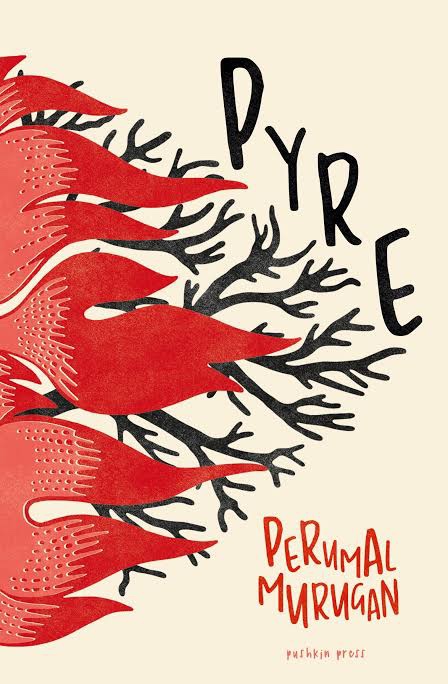
Perumal Murugan is an author, scholar and literary chronicler who writes in Tamizh. He has written ten novels; five of them have been translated into English. As a professor of Tamizh literature, he has made several contributions to research and academic study of Tamizh literature specific to Konganadu region. He courted controversy with his book Madhorubhagan which made him announce, ‘Perumal Murugan the writer is dead’. His novel Pookuzzhi (Pyre) was originally published in Tamizh in 2013 and translated into English by Aniruddhan Vasudevan in 2016. It has now been longlisted for The International Booker Prize 2023.

Pyre is a heart wrenching story of an intercaste couple, Saroja and Kumaresan. Saroja elopes and marries Kumaresan, who then brings her to his remote, arid and decrepit village of Kattuppatti, in the hinterland of Tamil Nadu. Upon arrival, the couple are welcomed with abuses, mourning and threats. Saroja becomes their easy target, and is showered with expletives and profanities, especially from the womenfolk, and Marayi, her mother-in-law. Each passing day becomes a living hell as the villagers become hell bent on knowing Saroja’s caste. As the story progresses, there seems to be no sympathy or changed behaviour by the villagers towards the couple, who believe that this marriage is an impending doom, and start plotting a heinous crime against them. The couple though, remain in love, crave love yet have no idea that the same love is a harbinger of hatred and enmity.

Pyre is a grim telling of the realities of caste differences and discriminations present in our society. Through this lens, Murugan tells a riveting tale of the people who put caste on a pedestal. He centres caste as the unrelenting, unforgiving protagonist in the book. You may despise its presence, still remain helpless, just like Saroja and Kumaresan. The internalised misogyny that Marayi spews onto Saroja, is a depiction of the ways in which caste and such other forms of bigotry manoeuvre, such that those who are oppressed become the oppressors.

The harsh landscapes and terrains of Kongunadu form an integral part of this story. The barrenness of the land which the author describes evocatively becomes deafening through the narrative. The villagers’ reverence to caste whilst ignoring its beguiling notoriety to cause persecution remains a passive subtext all through. Perumal has fleshed out his characters; be it a listless yet restive Saroja, a pensive yet petulant Kumaresan or a scornful and savage Marayi. Aniruddhan Vasudevan’s translation of Perumal’s crude and caustic prose is unparalleled. He has managed to imbibe the nuances of the original language during the tender moments in the book as well as during the diatribe. Being a Tamizh speaker myself, I appreciate and applaud the sensitivity and restraint in Aniruddhan’s translation.

Pyre is a disturbing read. Perumal Murugan writes to unnerve you, to push you out of your bubble, to give your prejudices and preordained thoughts a 360 degree spin. He makes us, the reader, a mute spectator to the atrocities as they unfold. But isn’t that true in real life too? Aren’t we/ haven’t we become mute spectators to all kinds of caste, gender, religion, social status based atrocities? Aren’t we/ haven’t we become complicit in this despotism?

~ JUST A GAY BOY. 😓

The Desert and the Drum

📍 Mauritania 🇲🇷

Mauritania is a sovereign country in Northwest Africa. It is the 11th-largest country in Africa, and 90% of its territory is situated in the Sahara. It achieved independence in 1960 from French colonialism but has since experienced recurrent coups and periods of military dictatorship. Despite an abundance of natural resources, Mauritania remains poor. It was the last country in the world to abolish slavery, in 1981, and criminalised it only in 2007. (Source Wikipedia)

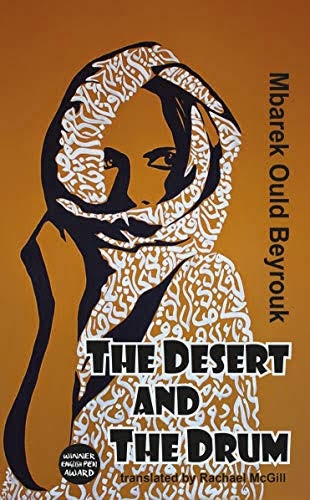
This book is the first novel ever to be translated into English from Mauritania. It was originally published in French in 2015 and translated by Rachael McGill in 2018. The book won the Ahmadou Kourouma Prize in 2016 (the prize was established in 2004 in honour of the Ivorian writer Ahmadou Kourouma, and it is awarded annually to works of fiction and nonfiction concerning Black Africa).

The story traces the journey of a young Bedouin girl, Rayhana, who has run away from her tribe and is on a mission to find the thing that has been snatched from her with force and deceit. While running away she has taken the sacred, symbolic and pious drum, rezzam, that belongs to her tribe and represents their pride and honour. She embarks on this perilous journey through the unforgiving Sahara and reaches a small town, Atar, and finally to the capital, Nouakchott. During this sojourn, she encounters various people who help her in their own ways, in achieving her mission, and also protect her from her tribe who are in search of her to retrieve their prized drum. Standout characters include that of the slave girl, Mbarka, who has now become a sex worker; and the very colourful and jovial queer guy, Hama.

The book is a raw, unapologetic and uncomfortable narrative of Rayhana’s turmoil. The chapters oscillate between the past and the present as does Rayhana’s thoughts from her secure yet stifling existence in her tribe, to the unknown and unwelcoming mores of the city life. She is torn about the fact that, she still cradles the belongingness she feels towards her tribe whilst despising the carefree and untethered cultural values of the city. She still remains a prisoner of her unpropitious upbringing, though freedom is now within her reach.

The author, Mbarek Ould Beyrouk, originally from Atar, is a journalist, who has written four books and has founded the country’s first ever independent newspaper. He gives an honest portrayal of the Bedouin life and their customs, and has kept the story rooted in Mauritanian ethos. The issues of patriarchy, misogyny, gender based violence, caste based oppression aren’t exclusive to Mauritania. Let’s get off our high horse, shed our condescension and pomposity, and examine the issues closely. They are as much prevalent behind the façades of glitzy high rises and modern lifestyles as they are in the humbling desert.

~ JUST A GAY BOY. 🥹

The Ardent Swarm

📍 North Africa

Tunisian author, Yamen Manai’s book, translated from French by Lara Vergnaud, is brooding and contemplative. This wonderful parable, can seem deceptively simple but is a rich tapestry of human emotions and behaviours. The story takes place in a far flung village of Nawa. Sidi, the beekeeper of the village, has devoted his life in taking care of his precious honeybees. However, one day when he finds them brutally massacred, he sets out on a quest to find the perpetrators behind the attack. He soon reckons that hornets are responsible for it and takes it upon himself to safeguard his bees from the menacing and dangerous hornets. At the same time, the unnamed country is going through a new post-Arab spring transition which sees the rise of radical fundamentalists to power. Using God, they are on a mission to convert the people into a bunch of zealots. As Sidi, grapples with the changing sociopolitical scenario and attitudes of people, juxtaposed with the imminent threat to his bees due to a natural predator, he comes to a realisation that human beings are far worse and vicious.

It won’t be too difficult to draw parallels, with the current political situation in our country. As zealotry and jingoism take centre stage, God has been weaponised to spread hatred, bigotry and radicalism. Is this going to be a massacre of our humanity?

~ JUST A GAY BOY. 😔🐝