Sista!

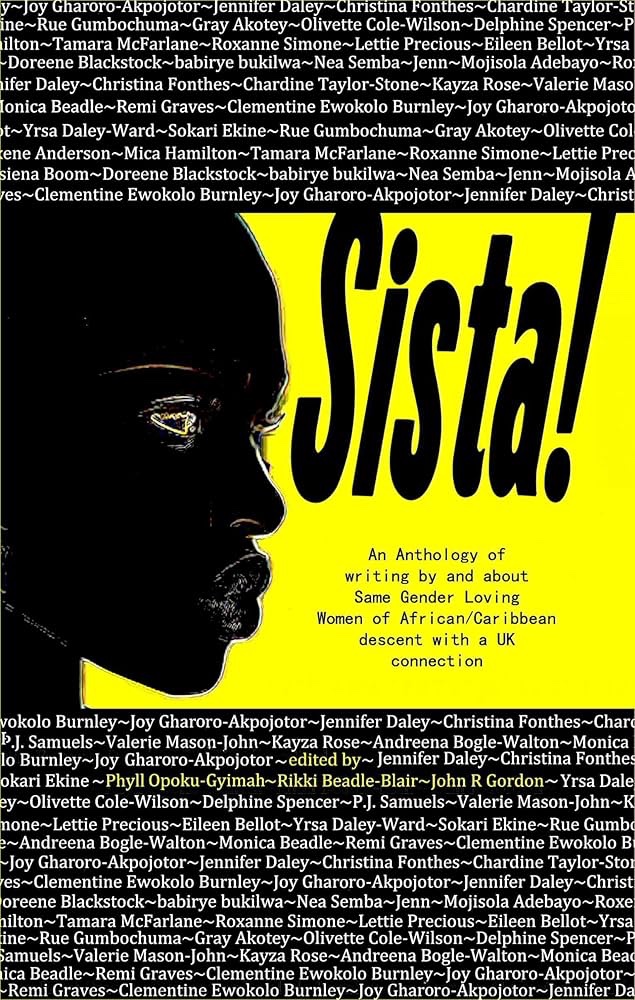
If you have read Black women writers, you would know that their writing is fierce, inspiring, creative and bold. They write with compassion and conviction, almost always to uplift one another and nurture the sisterhood, especially Black sisterhood. You can only imagine how much more intense and interesting the writing becomes when an anthology brings together a constellation of queer Black women writers. As the cover promises, Sista! is a brilliant collection of stories, poems, personal essays, (and even an interview) by and about queer women of African and Caribbean descent  with a connection to UK. 

While every contribution deserves recognition, a few pieces stood out to me for their authenticity, enviable audacity, and the incandescent freedom that radiated from their words. They are as follows:

  1. In her deeply personal essay, Not White, Not Ever: a Black Lesbian Lament, Kesiena Boom, a mixed-race, Black, lesbian feminist writer, reflects on the trials and tribulations of dating white women, and how race can be both, a catalyst to bring people together and one that also separates them, but can never be ignored. She also describes her failed attempts at having relationships with Black women and wonders what it takes for Black lesbians to seek and sustain romantic relationships and whether the overtly white lesbian landscape itself becomes a deterrent for Black women in visualising and creating meaningful partnerships.
  2. Author of 8 books and an inspirational Public Speaker, Valerie Mason-John’s Those Were The Daze, is a heartfelt rendition of what it means to be an elder of the Black Queer community. She revisits her struggles as a lesbian in the 80s including how her accidental coming out created both opportunities and hardships. She carefully explains her arrogance then which she adopted as an armour to tide over the anti-queer sentiment and reminds us in the most blistering way, how now more than ever, queer communities and queer people must look beyond racial, ethnic, religious and other socioeconomic differences and soldier on together as a singular powerful force.
  3. Tamara McFarlane’s poems are tender and evocative, with an equal measure of romance, sensuality and poignancy.
  4. Nea Semba’s tour de force essay, Supermalt, Self Love and Sexuality, is a rambunctious celebration of Black womanhood and the intersections between Black and Queer feminism. In this carefully constructed piece, the author, a non binary queer African, describes the significance of Black woman’s hair as an expression of her independence, authority, Blackness and queerness. Semba also confronts uncomfortable truths, including the persistent perception of queerness as a white thing and the tendency to attribute homophobia solely to religion while overlooking the roles of toxic masculinity and colonialism.
  5. In To be Femme: Lesbian Guerrilla Soldier, Chardine Taylor-Stone, an award winning cultural producer and feminist activist, succinctly elucidates what it means to be Femme and how embodying it as a queer woman of colour can itself be a radical act of feminism.
  6. Nigerian-British writer and visual scholar, Sokari Ekine’s Love in the Age [of] Evolution, is a hopeful and deeply moving reflection on dating, intimacy and discovering love at the age of 67. The essay brims with excitement and euphoria but simultaneously brings in the reality of dating with maturity and intention. She strongly asserts against the notion of age being considered a disability in the cis-normative world and how Black queer women are changing this very notion with their zest for romance, desire and companionship.

Sista!, edited by Phyll Opoku-Gyimah, Rikki Beadle-Blair and John R Gordon, is an illuminating anthology about lives and experiences that may initially seem distant from our own, but through them they reveal universal truths about reclaiming authority, autonomy and agency. The women writers bring in their unfiltered voices portraying their vulnerability and resilience and aren’t afraid to conceal their mistakes and shortcomings. The stories embolden us with extraordinary power, inviting us to restructure and recalibrate our own lives. They emerge from moments of existential crisis, yet arrive at places of balance and affirmation.

Few anthologies possess the ability to alter the way we see ourselves and the world. Sista! is one of them. It has the potential to change you at the molecular level, not because these writers set out to transform you, but because their stories have that innate ability to accomplish that quietly and organically. 

I end the review with this quote from Kayza Rose’s essay, When is the right time?,

I do hope we will come to a time where ‘coming out’ isn’t needed, and that being SGL (same gender loving) will be one of the norms of society. We still have a long way to go… but I do hope!

~ JUST A GAY BOY. 🏳️‍⚧️🏳️‍🌈

Universality

A lockdown rave by a group of nouveau political activists, The Universalists, becomes a crime scene that involves a gold ingot. Hannah is an investigative journalist trying to unearth the happenings of that day. Hannah has not had any luck in her professional life. She has been largely dissatisfied with her work and income and the pandemic has made it worse. So she jumps at the opportunity to investigate this outlandish story. The reportage propels her into the limelight; though when a movie adaptation of the crime is commissioned, she finds herself oddly sidelined.

The crime in question and also the first chapter of the book involves a young man, Jake, who bludgeons another guy, Richard Spencer, a capitalist mogul, with a gold bar and runs away with it. Jake is the son of Lenny, a journalist whose incendiary writing garners both controversy and admiration. These characters and a gold bar form the crux around which the author weaves in the story that becomes a powerful meditation on language, ideology and social justice. 

Natasha Brown’s’ second book, Universality, is a searing satire on the misuse, misinterpretation and manipulation of wokeness. The necessity of diversity in every sphere of life which had a global public interest leading to an awakening almost, has soon been chastised politically and has become a polarising topic. The liberality and equity that should be the cornerstone of any impartial society has become a means to manoeuvre the marginalised sections towards so called inclusive spaces just for tokenism and at the same time, these virtues have been weaponised as an attack on the meritocracy and social standing of the privileged and essentially a colourblind class. Through the characters in this book, Brown dissects the appalling banality of virtue signalling under the guise of which, multitudes of covert racism and ethnic appropriation take place and remain unchallenged. Brown’s language in the book reflects the performative morality that has become a part of the societal zeitgeist and goes unchecked in these polite, progressive circles which simultaneously is also quietly dismantling the real woke phenomenon and anti-capitalist doctrine.

The character that stood out to me in this ensemble of white characters was Lenny. A provocative writer who has positioned herself as an antiwoke messiah and whose speeches and writings now provide succour to the disgruntled elite. Her flippancy, her disregard for any possible retribution for her acerbic vitriol on liberalism yet commanding applause and admiration for her attack on chauvinism and misogyny, makes her a morally grey character. Despite her obviously problematic persona, I couldn’t stop myself from rooting for her when she stands her ground against the chauvinistic interviewer at the literature festival. This left me questioning my own moral compass and I was bewildered at my judgement or lack there of; that, when I was faced with racism and feminism, I chose a racist feminist without a second thought. And this brings me to the brilliance of Natasha Brown’s Universality, which has shown that racism, colorism and featurism can come disguised as feminism and diversity, and it can remain undisputed and oblivious. 

Natasha Brown, as an author has grown with this book. In Assembly, her writing was a tad stifling and claustrophobic. It almost felt, she was being cautious. However, with Universality, she is decidedly defiant. She’s unabashed, unapologetic and completely fearless. As a Black author, Brown has written Universality, which is about white people and their morbid obsession to be seen as an all-encompassing and racially benevolent group. Hence, the book is radical in many ways and presents a brand new voice that is determined to make you uncomfortable about your conscious and unconscious biases. 

Now, I do have a thought. If one were to replace the whites in the book with the upper castes in India, the language would not change at all. The dynamics would hold. Because there is, I believe, a sinister universality that ties racism and casteism together. 

~ JUST A GAY BOY. 🌝🌚

Assembly

A Black British woman whose family is from Jamaica, has had a good education and is now working as a financial executive in London who’s slated for a promotion. She has a white boyfriend whose family has an estate and has been bestowed with ancestral wealth. She is hesitant to attend the boyfriend’s parents’ anniversary party at their estate over the weekend. The boyfriend adores her and is excited to introduce her to his family. Now, from the outside, everything seems like a dream and the narrator is seemingly living the proverbial good life. Is she really?

Assembly is an internal monologue of the narrator as she goes about living her life. A life that appears perfect to the world, is in actuality, diametrically opposite to it. The narrator visualises herself and her life through the racial constructs of an apparently colourblind society only to find it hypocritical and dismissive of her struggles and lived experience. Colourism and chauvinism come disguised as diversity that beguilingly disregards her competence and contribution. Microaggressions become insidiously inherent part of her personal and professional relationships. Her existence always gets measured by her achievements and simultaneously the same achievements get scrutinised for their authenticity and credibility. The narrator is forever filtering and self editing her thoughts and actions leading to an unconscious reaction or an instinctual internal censoring. This habitual silencing results in extreme frustration, repressed emotions, distress, resentment causing alienation, emotional dysfunction and cognitive dissonance. 

Natasha Brown’s Assembly is a brave new voice in the world of literature that is trying to dismantle racism and colourism. The acerbic rhetoric feels like a whiplash at times. The brevity of the writing is no hindrance to the profundity each word provides to the central issue. Brown’s economy of language is a reflection on the stifling effects of racism on consciousness and conditioning. However, despite the meritocracy, I did find the rendition a tad flawed, especially when the narrator gets diagnosed with a disease. I couldn’t help but wonder, the necessity of that incident and also the intention of the author behind it. Was the disease introduced as a way to mollycoddle the readers into sympathising with the narrator and to align us with her complicity? Was it an easy way out for the author to refrain the readers from taking a stand against the narrator for the choices she never makes and for her perpetual rumination on society’s racism? Was Natasha Brown subtly illustrating the physical toll of suppressed anger and racial frustration? I know my opinion does appear controversial, but I wouldn’t have minded the narrator’s connivance, hesitancy to question and non confrontational stand, because she’s the victim of covert racism and that is something, that is always deemed speculative and unsubstantiated. So though we readers would have wanted the narrator to take a stand, to pacify our unsettled emotional core, we need to ask ourselves, if the narrator had a choice. And if she did have a choice, could she have executed it and at what cost? Hence, I wonder again, if Natasha Brown was deliberate in sugarcoating the narrator’s helpless reality. 

Nonetheless, keeping my nitpicking aside, I do strongly recommend Assembly

~ JUST A GAY BOY. 😐

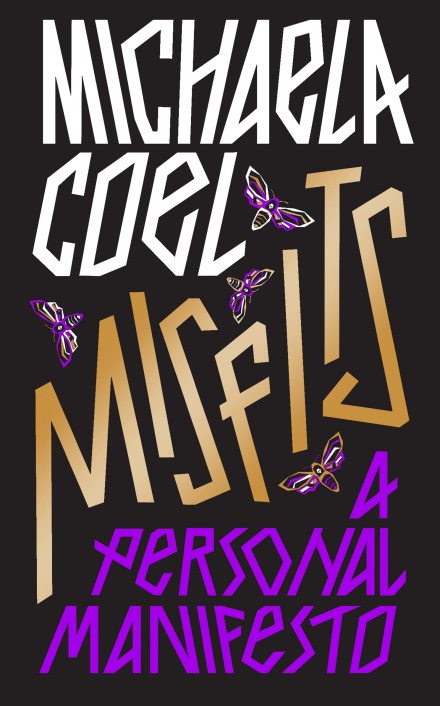
Misfits: A Personal Manifesto

When Michaela Coel, Emmy and Bafta winning creator/actress, also one of my most favourites; writes a book, you know it’s going to be real and cerebral. This book was inspired from Coel’s prestigious 2018 MacTaggart Lecture, a high-profile address given yearly by a keynote speaker at the Edinburgh Television Festival. Through the book, Michaela lays bare her deepest truths, fears, insecurities and idiosyncrasies.

From growing up in a poor family and as a black woman, in East London; to navigating racial slurs at drama school and not being taken seriously enough in the television industry despite two hit shows, Chewing Gum (Netflix) and I May Destroy You (BBC/HBO); Michaela describes her unconventional journey in a very poignant and purposeful narrative. She also talks about her sexual assault, which later prompted her to make the ingenious and hard hitting show, I May Destroy You, centring it on the issues of thefts of consent and rape.

Michaela refers to herself as a misfit and champions for all the misfits like her in the book. In this sensational agenda setting debut, she makes a compelling case for radical honesty and greater transparency. She believes that we as a world, need to be inclusive and respectful of every other human. She stresses on the fact that we need to constantly reflect on our thoughts, actions and words; for the betterment of humanity at large.

“ I’ve decided to embrace as many perspectives as I can, and be brave enough to update my beliefs, and discover I’m not always right. What a brilliant thing, to discover we’ve been wrong about some things, what a brilliant thing it is to grow”.

A brilliant and humbling read indeed!

~ JUST A GAY BOY. 🙌